
The short version
- 3 business days to respond once a buyer opens a return, 2 business days to refund once it is back with you - miss either and eBay can act without asking you.
- Who pays return postage depends on why they are sending it back. Damaged, faulty or not as described: you pay, every time, even if you do not normally offer returns. Changed their mind: whatever your returns policy says.
- An unresolved return counts as a defect on your account - not the return itself, the not-dealing-with-it.
- Your "item not as described" rate is tracked on its own, compared against sellers like you, and a high one gets your delivery dates extended and your fees raised automatically.
- For low-value items you can refund without asking for the item back at all - a real option, since you never held the stock to begin with.
What actually happens when a buyer opens a return
A buyer has 30 calendar days from delivery to open something against your order - either "item not received" or a return, both covered by eBay's Money Back Guarantee (eBay US runs the same 30-day window). The moment they do, you get an email and a notification in eBay Messages, and the clock starts: eBay gives you 3 business days to respond. Do nothing, and eBay is direct about what happens next - it may "refund the buyer and seek reimbursement from you, without requiring the buyer to send the item back." You lose the item, the sale and the postage, and you never got a say in it.
There are three reasons a return lands on your desk, and they are not equivalent:
- It does not match the listing, or arrived damaged or faulty. This is covered by the Money Back Guarantee outright. You cannot decline it, and you pay the return postage regardless of your stated policy.
- They changed their mind, or ordered the wrong thing. Whether you accept this at all, and who pays if you do, is entirely down to the returns policy you set - see setting up your business policies if that is not done yet.
- It never arrived. A different flow (tracking, not a physical return), but the same 3-day clock and the same Money Back Guarantee.
Everything below is about the first two - an item that did arrive, and now has to go somewhere, or be paid for.
Step 1: Read why they are returning it before you do anything
The reason the buyer selected when they opened the return decides your options, so it is the first thing to check, not the last. Open the request and read the actual reason code, not just the buyer's message - people often word the message more mildly ("doesn't really work for my space") than the box they ticked ("doesn't match description"). The reason code is what eBay measures you against, and it is what decides who pays for the postage in the next step.
A return is not a failure. Not looking at it for four days is.
Step 2: Work out who pays the return postage
This is the part sellers get wrong most often, because it feels like it should be one rule, and it is actually two:
| Damaged, faulty or not as described | Changed their mind | |
|---|---|---|
| Who pays return postage | You, always - eBay's guidance says this applies "even if you don't normally offer returns" | Whoever your returns policy says. Offer free returns and it is you; otherwise it is the buyer |
| Can you decline it | No - the Money Back Guarantee covers it outright | Yes, if your policy states you do not accept change-of-mind returns |
| Counts against your account if... | ...you do not resolve it and eBay has to step in - same rule, either reason | |
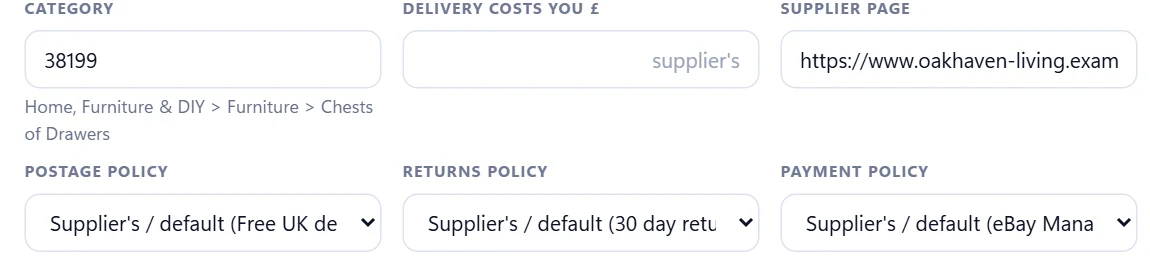
Because dropshipping means you never held the stock, this is worth setting deliberately rather than accepting eBay's default. Most dropshippers set their returns policy to not accept change-of-mind returns at all, which eBay allows, while staying ready for the ones it does not let you decline. See how to set that policy up properly, per supplier, if it is not already in place.
When you do owe the postage, eBay gives you a few ways to arrange it: upload your own label, send the buyer tracking details for a label you have posted to them, send them the money to buy one themselves, or arrange a pickup. What you cannot do is send a buyer money for postage and get it back from eBay if they then decide not to return the item after all - that is not refunded to you.
Step 3: Get the item moving, or decide it does not need to
Since you do not hold stock, a returned parcel has to go somewhere - usually your own address, because eBay needs a real return address on the account, not the supplier's. For anything genuinely low in value, though, there is a better option than asking for it back at all: under Return preferences, you can set an amount below which eBay will let you "let buyers keep the item and automatically refund them" - no parcel, no address, no wait. For anything worth a few pounds after the supplier's cost, that is usually cheaper and faster than having it sent back to you at all.
Step 4: Refund on time, or eBay will do it for you
Once the item is back with you, or you have decided it does not need to be, you have 2 business days to review it and send the refund. Private sellers pay it from their eBay balance; business sellers from their Available and Processing funds, falling back to a linked account if there is not enough there. Miss the 2 days and eBay will "automatically deduct the amount from the total of your Available, Processing, and On hold funds" and send it anyway - you keep none of the control and all of the outcome.
You actually have up to 90 days from the original sale to issue a refund at all, which is worth knowing for the odd case that does not fit the standard return flow - a goodwill gesture, a mistake you spot yourself, a partial refund for something that arrived slightly marked but still usable.
Returns cluster after your busiest weeks
Expect more of them right after a peak sales period - January after Christmas buying especially - not evenly through the year. Budget the time for it in the week or two after your busiest stretch, the same way you would budget wider delivery times going into one.
What a slow or mishandled return actually costs you
None of this is really about the one return. It is about what an unresolved one does to the account underneath it. eBay's own seller standards policy is specific about what counts: a transaction defect is when "the buyer reports an issue, but the seller doesn't resolve it (a case closed without seller resolution)" - eBay reviewed it, and found you responsible. That is the trigger, not the return itself. A return you handle promptly and refund on time never touches your standards at all.
Once it does, it counts twice - toward your cases rate (capped at 2, or 0.3% of transactions, whichever is higher) and your transaction defect rate (capped at 2%). Both are rolling monthly figures, and both feed the account-level seller status that your fees, visibility and eligibility for promotions are built on.
The "item not as described" rate is tracked on its own
Separately from defects, Seller Hub's service metrics track how often buyers report an item as not received or not as described, specifically compared against "other sellers like you" doing similar volume - not a fixed number, a moving benchmark against your peers. Run high here and, on eBay's own wording, it can mean eBay "may place limitations on your selling activity - including extending delivery dates or charging higher final value fees - until your performance improves." That is an automatic, account-wide penalty, not a warning email you can leave sitting in an inbox.
For a dropshipper specifically, this rate is often more about the listing than the return: if the size, material or condition drifts even slightly from what actually arrives, buyers select "not as described" more often, whether or not they would have accepted a quiet refund either way. Photos and specifics taken straight from the supplier's own listing, not a rewritten guess, keep this number down before a single return ever happens.
When eBay removes the defect for you
Not every bad outcome sticks. eBay's seller standards policy says it will "remove defects and/or late deliveries when things happen that are outside of your control, such as severe weather or carrier disruptions" - and if a buyer breaches eBay's Abusive Buyer Policy, any defect tied to that case is removed automatically, without you having to ask. Worth knowing, so a genuinely unfair case does not sit there worrying you for a month it was never going to count against.
How Sellhelm keeps a return from becoming a mess
None of the steps above change because you are using software, but they get a great deal less stressful. Sellhelm's Orders page pulls a fresh 90 days from eBay and gives Need attention and Cancelled / refunded their own cards, separate from the ones you do not need to look at right now - press either to see just those orders, not scroll the whole list looking for them.
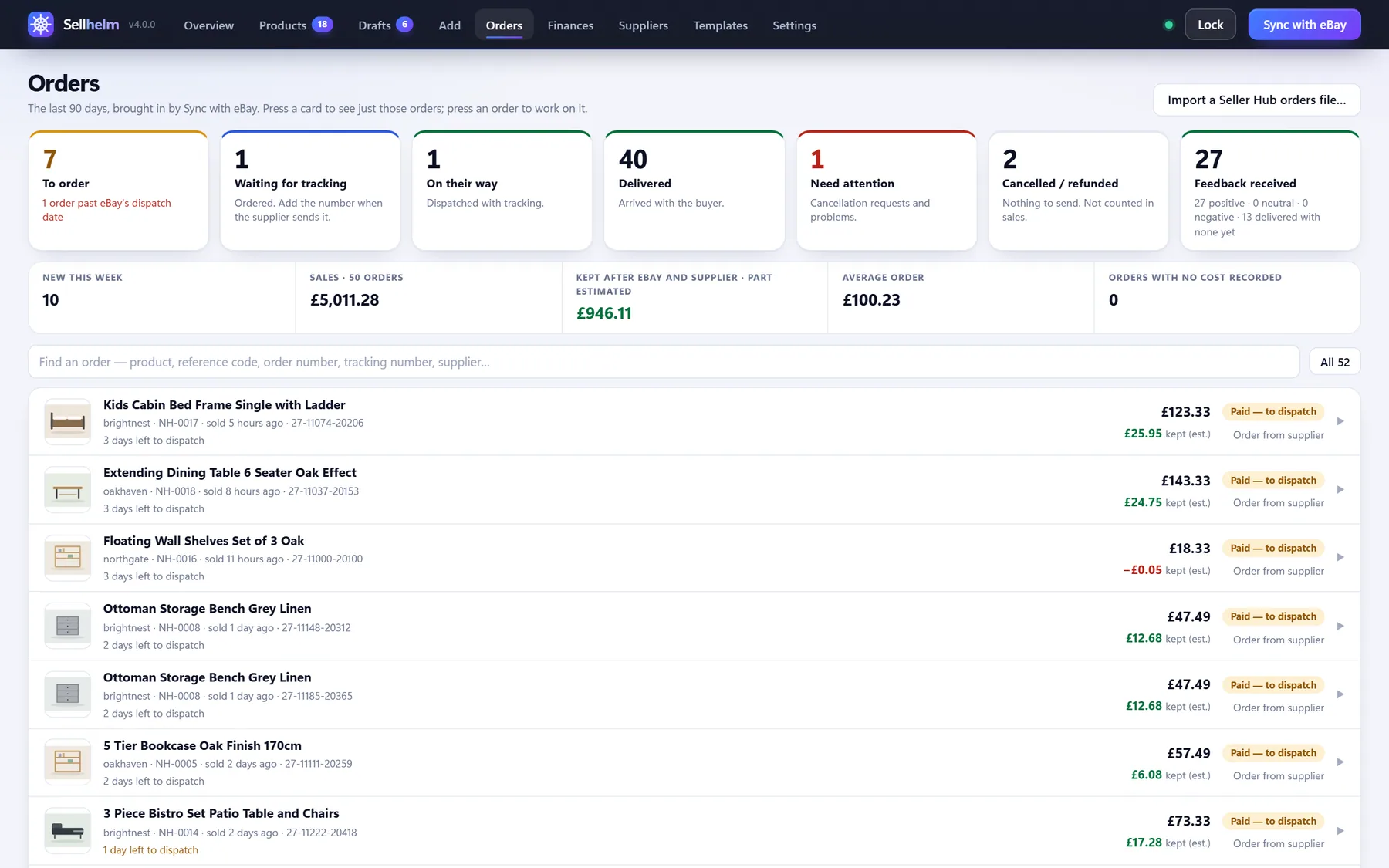
Every order carries its own status - paid, to dispatch, dispatched, delivered, cancellation requested, cancelled, refunded - so you always know exactly which one you are looking at, and you can search by product, order number, tracking number or your own supplier reference to find one fast when a buyer messages about it.
The buyer's address, when a return does need to come back to you, is read live from eBay the moment you open the order and never saved by the panel - one thing fewer to get wrong, and nothing sitting around that should not be. And because Finances works from the same live figures, a refund shows up in what you actually kept for that order, not just in the sales total it started as.
Questions people ask
Who pays for return postage when I dropship on eBay?
It depends on why the item is coming back. Damaged, faulty or not as described: you pay, always, even if you don’t normally offer returns. Changed their mind: whatever your own returns policy says - free if you offer free returns, otherwise the buyer.
Do I have to accept change-of-mind returns?
No. You can set your returns policy to decline them outright, which most dropshippers do since a returned parcel has nowhere obvious to go. You still have to accept returns for anything genuinely damaged, faulty or not as described - that part is not optional.
What happens if I miss the 3-day or 2-day deadline?
Miss the 3 days to respond to a return, and eBay may refund the buyer and try to recover the money from you without the item ever coming back. Miss the 2 days to refund once the item is back with you, and eBay issues the refund itself and takes the amount from your funds.
Does a return always count against my seller account?
No - only an unresolved one does. eBay counts a transaction defect when a buyer reports a problem and you do not resolve it, so eBay steps in and finds you responsible. A return you handle and refund inside the deadlines never touches your seller standards.