

I've been doing eBay dropshipping for a few years now, and if I had to start again from zero today, I'd do quite a lot of it differently from what you see in most videos on the subject.
I wouldn't try to build 10,000 listings in a month. I wouldn't chase a specific number by a specific date. And I definitely wouldn't treat it as passive income, because it isn't - not for the seller, and not for the buyer who is trusting you with their order.
I'd start small, learn the account, get the processes right, and scale from there. Here's exactly how I'd approach it, point by point.
I sell on eBay UK, so the figures below are in pounds and a couple of the links are to eBay's UK help pages - but every lesson here applies just as directly whether you're on eBay UK, eBay US or another eBay marketplace. The mistakes are the same; only the currency changes.
The short version
- Start small: 5 to 10 listings a night, and master the order-to-refund process before you scale.
- Customer service decides the outcome, not the product - the supplier's mistake is still your problem to fix.
- A price that "looks" profitable often isn't once every fee, tax and return is actually counted.
- Stock and price monitoring stops a quiet supplier change from silently costing you the sale.
- eBay allows wholesale dropshipping, not retail arbitrage after the sale - know which one you're doing.
- A smaller, well-managed catalogue beats a huge one: 200 products you watch closely outperform 10,000 you don't.
1. Start small, on purpose
I'd create a new eBay account and start slowly: maybe 5 to 10 products a night, rather than uploading hundreds or thousands of listings immediately. Then I'd focus on getting a few sales and managing them properly, start to finish:
- Get the order
- Pay the supplier
- Make sure it's dispatched
- Upload tracking
- Answer the customer
- Make sure it arrives
- Deal with any problems, then do it again
I'd much rather have 10 orders I can manage properly than 100 orders I'm struggling to keep up with. A new account with a short, clean history is worth more to you long-term than a big one with a rocky start - see the section on eBay's rules below for why that history matters more than it looks like it should.
2. Customer service is everything
This is probably the single biggest lesson I've learned. Dropshipping isn't passive income - you're the middle man, and the customer doesn't care where you got the product from. They bought it from you.
Supplier doesn't have stock? That's your problem. Wrong item gets sent? That's your problem. Customer wants to return it? That's your problem. Courier is late? That's your problem. Customer sends you a message? That's your message to answer.
You can automate a lot of the boring, repetitive parts of this - reading stock, working out a price, drafting a listing - but you can't automate responsibility. When something goes wrong, it's still you who has to sort it out.
How you sort it out is what eBay actually measures: cases closed without your involvement, late deliveries and item-not-as-described rates all feed into your seller standards level, which decides your fees and how visible your listings are.
3. Get your shipping policies right
Don't promise customers something your supplier can't reliably deliver. If I know a supplier normally takes around 3 days, I make sure my stated delivery time gives me some reasonable breathing room rather than making unrealistic promises just to make a listing look more attractive.
And always upload tracking the moment an order is dispatched. Once it's dispatched, keep an eye on that tracking - don't just click "dispatched" and forget about it. A parcel that stalls in transit is still your responsibility to notice, not just the courier's.
4. Returns are part of the business
This is where a lot of beginners get caught out. A customer wants to return something? You don't just tell them "contact the supplier." You sold the item - you need to manage the return.
My process is always the same: customer requests a return, I contact the supplier, get the correct return instructions, pass them to the customer, monitor the return, confirm it arrives back, then refund the customer. I do it professionally every single time, even if the customer is difficult, and even if the problem wasn't my fault. Stay professional and solve the problem - it's cheaper than the alternative.
5. Answer messages quickly
Don't leave customers waiting for days. If you know the answer, answer it. If you don't, tell them you're looking into it - even something as simple as "I'll look into this for you and get back to you" is better than silence.
I've always believed that if you deal with customers properly, a problem can often become nothing more than a minor inconvenience. Ignored, the same problem becomes a return, a bad review, or a case opened against your account.
6. Make your listings stand out
Don't just throw a supplier's product onto eBay and hope for the best. Good titles, good images, clear descriptions, and the important information somewhere easy to find - none of it is complicated, but it's the difference between a listing that looks like a real shop and one that looks like it was uploaded in ten seconds.
Personally, I use HTML templates with the product images built in, so the finished listing looks more professional; the images are then hosted through eBay itself once the listing is published, so nothing depends on a third-party image host staying online.
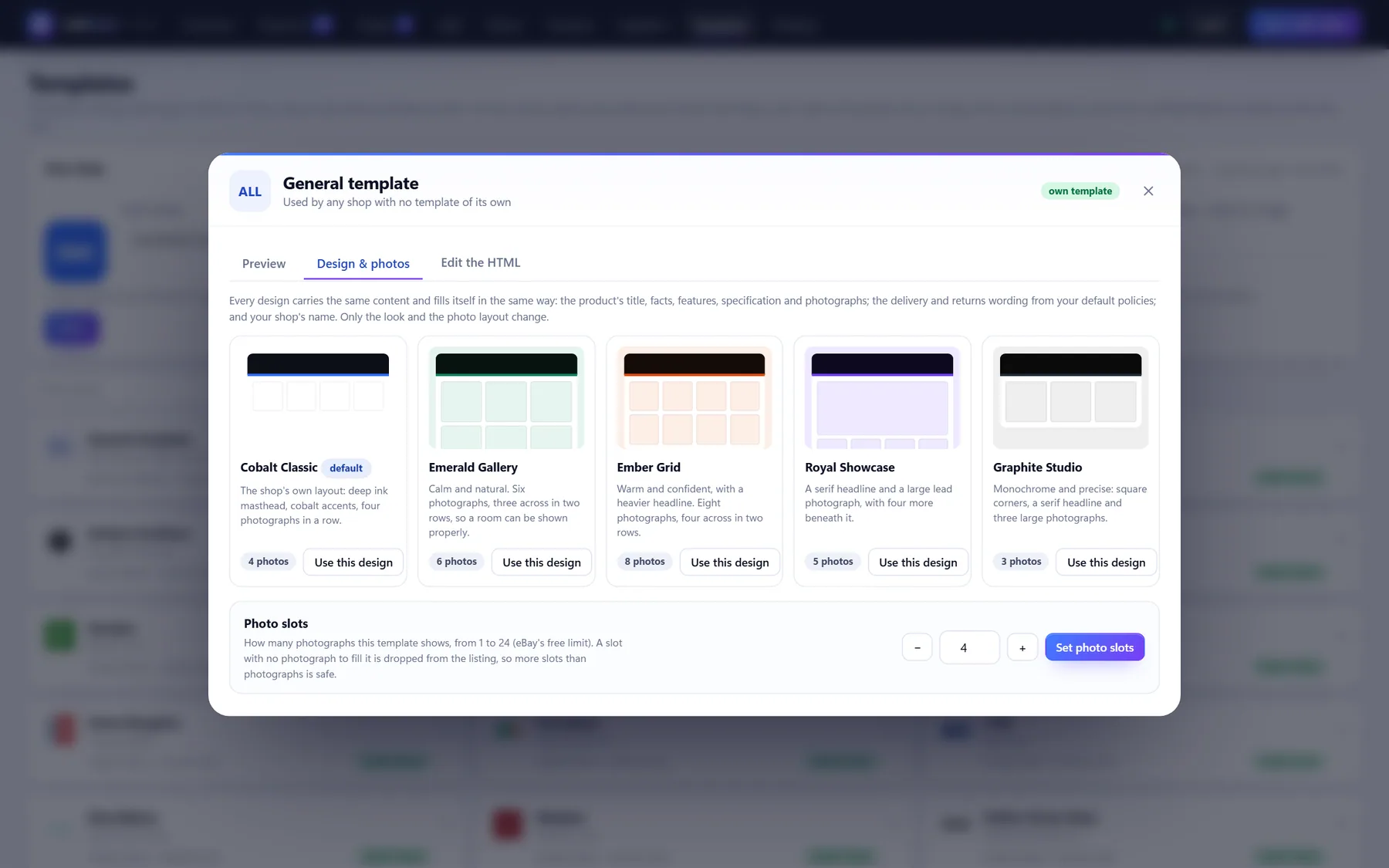
You don't need to reinvent the wheel here. Just make the listing look like someone actually cares about it.
7. Monitor stock and price, properly
If you're dropshipping and manually checking every supplier every day, you're eventually going to miss something. Supplier changes the price? You need to know. Supplier runs out of stock? You need to know. Supplier changes the delivery time? You need to know.
Imagine selling something for £49.99 when your supplier charges £30. Looks good - until the supplier increases their price to £45 and you don't notice. Someone buys it, and your margin has quietly disappeared. Or the supplier sells out completely, and you're looking at cancelling an order you already confirmed.
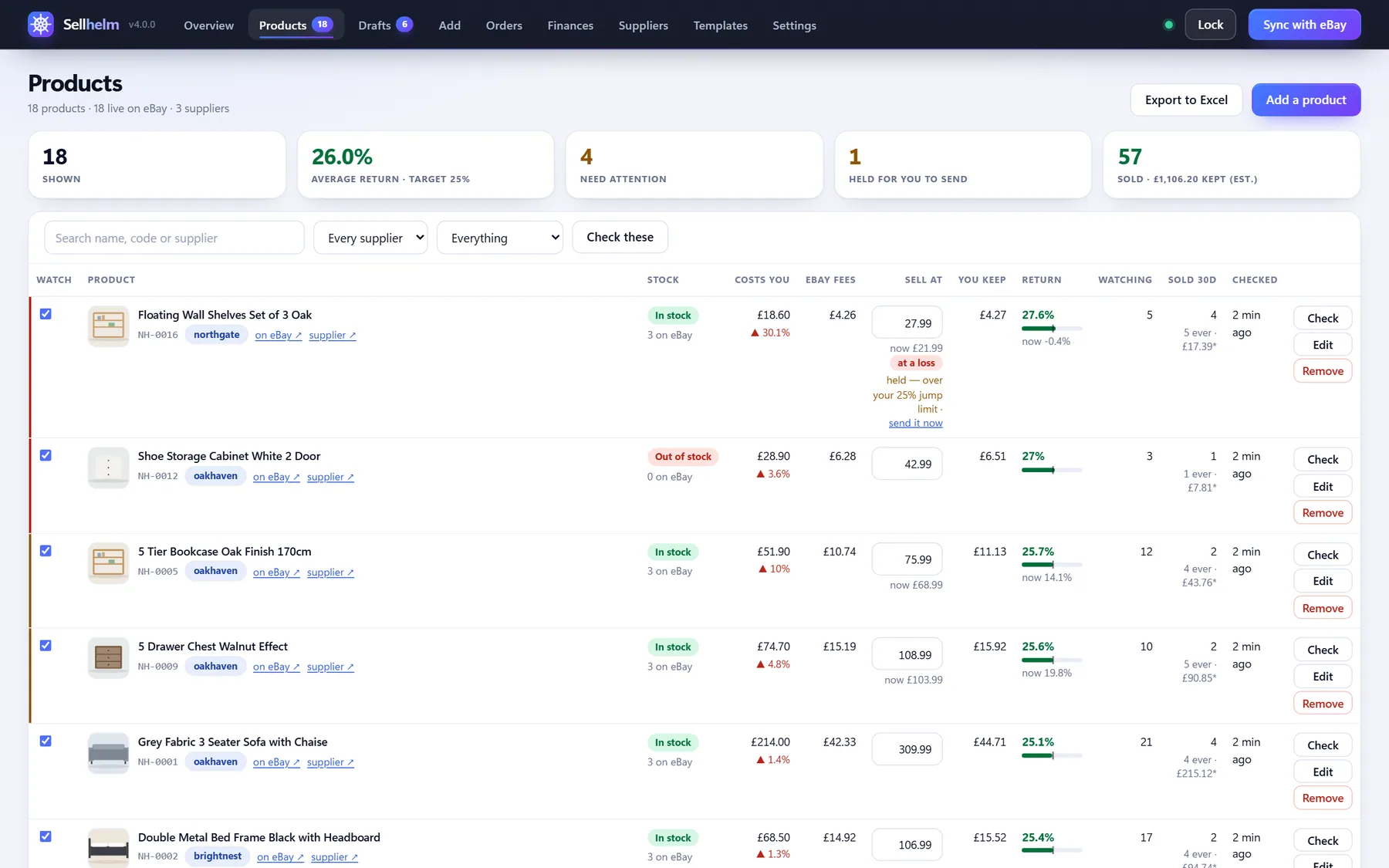
I would always use some kind of stock and price monitoring unless I was holding the product myself. This is the exact problem Sellhelm's price and stock watching exists to solve, and it's covered in more depth in keeping stock and prices in sync.
8. Know your real numbers
This sounds obvious, but I've made this mistake myself. You sell something and think "nice, £10 profit" - then you actually calculate everything and realise you've made £1, or lost money outright.
The calculation needs to include everything: supplier cost, eBay fees, postage, VAT where it applies, discounts, returns, and any other cost that touches the sale. "Sale price minus supplier price equals profit" doesn't work, because it leaves out most of what actually comes off the top.
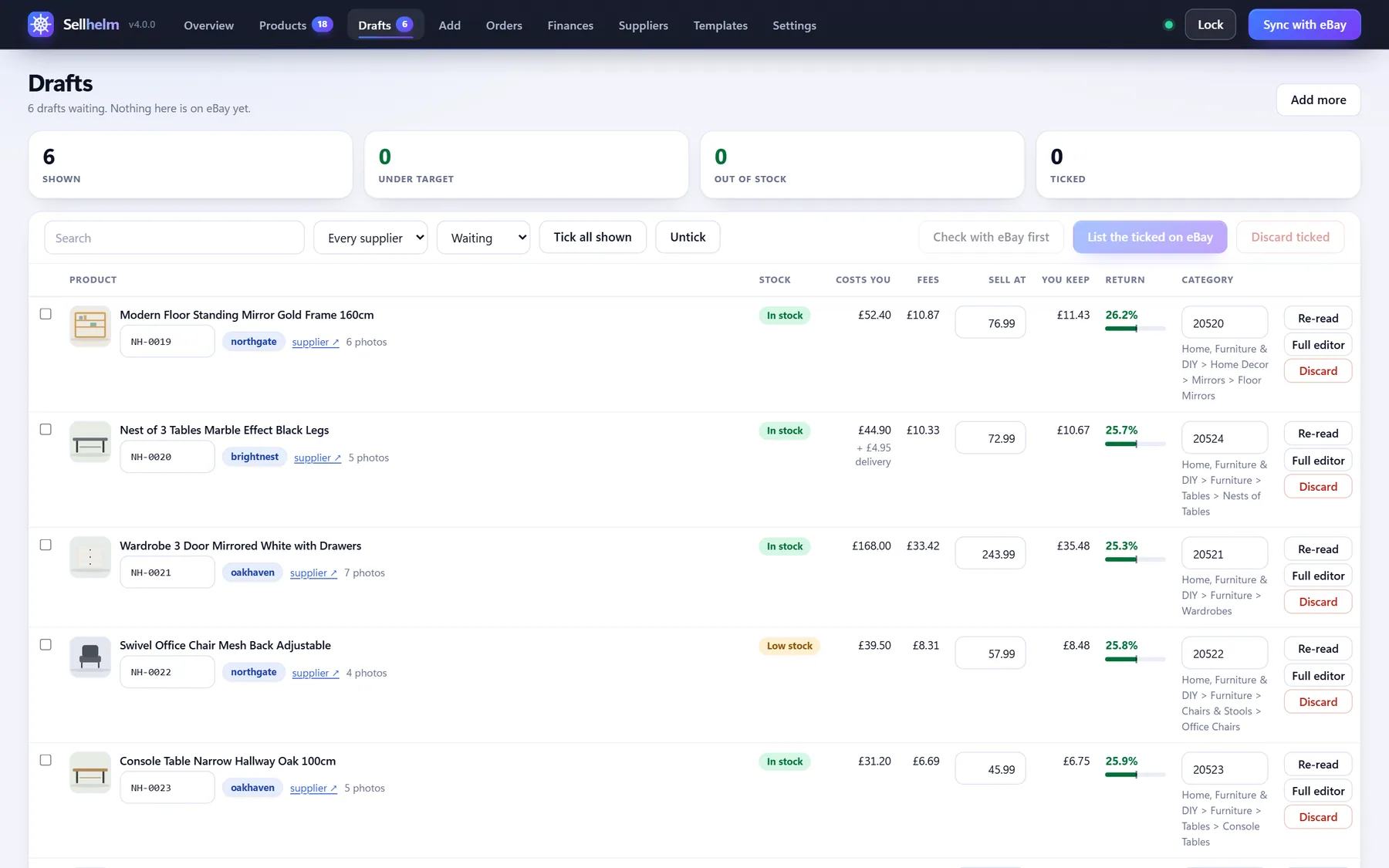
I've personally had products where I only realised afterwards that the real margin wasn't what I thought it was, and sometimes I've just accepted the small loss rather than mess the customer around - I'd rather lose a few quid on one order than create an unhappy customer over my own mistake. The better fix, obviously, is to catch it before the sale: Sellhelm's fee calculator is free to use for exactly this, worked out the same way as the pricing inside the program.
9. Have money available
This is something beginners often overlook. You can make a sale today without necessarily having immediate access to that money - eBay can place holds on funds, particularly for a newer or infrequent seller, sometimes for as long as a few weeks while it confirms an order has gone smoothly. eBay's own payment-hold policy explains when and why.
So if you're selling £100 products, don't plan on using the customer's money to pay the supplier - you may need to fund that order yourself while your eBay funds are held. I'd start with lower-cost products, build up cash flow, and make sure I had enough money available to cover orders for at least the first couple of weeks before relying on eBay's payouts to keep the business moving.
10. Don't fall into the "I need 10,000 listings" trap
You don't. I'd much rather have 200 decent products than 10,000 that nobody wants. What I normally look at is views, watchers and sales: if something is getting views and watchers, there's clearly some interest, so I keep it and monitor it, maybe improve the listing. If something has been sitting there for weeks with basically no interest, I remove it and replace it with something else.
I'd rather constantly improve a smaller catalogue than blindly build a massive number of listings that mostly just sit there doing nothing.
11. Look after customers after the sale
Don't forget about the customer the second the parcel arrives. Leave feedback, make sure everything went okay, and where it's appropriate, politely ask if they'd be willing to leave feedback themselves - without spamming or hassling them. Just provide a good experience. Your feedback and seller history are genuinely valuable, and they're built one order at a time, not bought.
12. Don't ignore eBay's rules
This one matters, and it's the same rule wherever you sell: eBay's policy allows dropshipping from a wholesale supplier, but is explicit that buying an item from another retailer or marketplace after you've made the sale, and having that retailer ship directly to your customer, isn't allowed on eBay. eBay calls this out directly on its own dropshipping page, worded identically for eBay UK and eBay US.
There are plenty of sellers you can find on eBay who appear to have been doing retail arbitrage for years. But "other people are doing it" doesn't mean eBay allows it, and you can't know why one seller's account has survived while another has disappeared. If you're going to use a particular sourcing model, understand the current rules and the risk you're carrying - the eBay dropshipping policy guide goes into this in more detail, and it's worth reading before you build a shop around a method you haven't checked.
13. What I'm doing now
Interestingly, I've recently started another eBay shop myself, using retail arbitrage and focusing on furniture. I don't mind saying that, because I'm experimenting with the model myself and it's genuinely early days. The reason I like furniture is that the perceived value can be much higher, with considerably better margins than some of the cheaper products people normally associate with dropshipping.
There's a real downside, though: you need more capital. A £200 product ties up a lot more money than a £20 one, so it's not necessarily where I'd tell someone with no experience or very little capital to start. For me, it's going well so far - but that's one data point, not a promise.
14. Automation is great - but it doesn't replace you
You can automate loads: stock checking, price monitoring, order information, tracking, product research, listing processes, alerts, and parts of customer communication. That's most of the boring, repetitive work, and it's genuinely worth automating.
But when a supplier says "sorry, we're out of stock," someone has to deal with it. When a customer says "I've received the wrong item," someone has to deal with it. When someone wants to return something, someone has to deal with it. That's you.
You're responsible for the customer, the order, the returns, your margins and your account, and that's exactly why I don't consider dropshipping passive income - and, for what it's worth, it isn't really a hobby either: if you're regularly selling to make a profit, it's a business, with real tax and reporting obligations wherever you sell from. I'm in the UK, so HMRC's own guidance on working for yourself is the one I check; wherever you sell, your own tax authority will have the equivalent, and it's worth fifteen minutes of anyone's time before their first sale.
So, if I was starting again tomorrow
I'd keep it simple. Start with a handful of products. Get some sales. Learn how eBay works and what customers expect. Work out which suppliers are actually reliable. Monitor stock and prices. Work out margins properly. Remove products that don't perform, and add better ones. Build up cash flow. Then slowly scale.
I wouldn't care about having 10,000 listings. I'd care about having a healthy account, happy customers and profitable products - in that order.
My biggest lesson. A lot of people get into dropshipping after watching someone say "find a product, list it, automate everything, and make money while you sleep." That's not reality. Dropshipping can work, but it's still a business: you're responsible for the customer, the order, the returns, your margins and your account. You can automate a lot of the work, but you can't automate being responsible for what happens. I've made plenty of mistakes over the years - sold products for less profit than I should have, missed price changes, had supplier issues, dealt with returns, had customers who were difficult - and I've learned from all of it. If I had to start from zero today, this is exactly the approach I'd take.
Questions people ask
Is eBay dropshipping still worth it?
It can be, but it is a real business, not passive income: you are responsible for the customer, the order and the return whatever went wrong upstream. Sellers who treat it that way, price properly after every fee, and keep on top of stock and price changes are the ones who last.
Is dropshipping against eBay's rules?
Not if you source from a wholesale supplier who fulfils the order for you. eBay's own policy is explicit that buying an item from another retailer or marketplace after the sale, and having it shipped directly to your customer, is not allowed - see the eBay dropshipping policy guide for the detail.
How many listings do I need to start?
Far fewer than most people assume. Two hundred products you can manage properly, priced correctly and genuinely in demand, will outperform ten thousand that nobody is watching. Start with 5 to 10 a night and build from there.
How do you stop a supplier price change from costing you money?
Some kind of ongoing stock and price monitoring, so a change is caught before someone buys at the old price. See keeping stock and prices in sync for how that actually works, or Sellhelm's features for how the program does it.