
Fee facts last checked 10 October 2026 against eBay US’s selling fees page. Rates change and vary by category, so the examples below are examples, not your rates.
The method in one minute
- Add up what the item really costs you: the supplier’s price plus any delivery you pay.
- Choose the return you want on that spend, for example 25% (spend $100, keep $25).
- Find the price that delivers it after every eBay fee. The fees grow with the price, so you cannot just multiply.
- Set a floor and a ceiling, round up to a neat ending, and re-check whenever a supplier’s price moves.
The rest of this guide explains each step with real numbers, and shows how to automate it so it stays true on every listing.
Every cost that comes off a sale
Start with the total the buyer pays, item and shipping together, because eBay’s fees are worked out on all of it. From that total come:
- The final value fee: for most categories 13.6% of the total amount of the sale, up to $7,500, and 2.35% on any part above that. Some categories differ. The fee calculator has eBay’s own rate built in for every category.
- The per-order fee: $0.30 for orders of $10 or less, $0.40 above.
- Sales tax is collected and paid by eBay, so you never receive it, but eBay works its fee out on a total that includes it. Sellhelm allows a typical 7% for that (a setting you can change in Settings, Pricing), and so do the sums in this guide.
- Your supplier’s price and any delivery you pay.
- An allowance for returns and refunds, because some will cost you.
- Any optional extras you choose, such as eBay’s paid promotion, packaging, or a payment to a service. These are real costs and belong in the sum if you use them.
Add them up honestly and you know the smallest price that breaks even. Everything above that is profit.
A receipt for one sale
Here is exactly where the money goes on an item that costs you $20.00 in total, sold at the price aimed at a 25% return and rounded up to a .99 ending (a flat 13.6% final value fee, worked on the sale plus a typical 7% sales tax):
| Buyer pays (item and shipping) | $29.99 |
|---|---|
| Final value fee | − $4.36 |
| Per-order fee | − $0.40 |
| What the item cost you | − $20.00 |
| You keep | $5.23 |
eBay’s fees alone take $4.76 of a $29.99 sale. That is why a price copied from a competitor, or a simple markup, so often turns out to lose money.
Markup, margin and return on spend
Three ways of describing the same profit give three different numbers, which is where sellers go wrong. Using the sale above:
- Markup is the price over the cost, ignoring fees: $20.00 to $29.99 looks like a 49.9% markup. It says nothing about what you actually keep.
- Margin is profit as a percentage of the selling price: $5.23 on $29.99 is 17.4%. Always smaller than the return, because it is measured on a bigger number.
- Return on spend is profit as a percentage of the money you actually spend on the item: $5.23 on $20.00 is 26.1%. It answers the question that matters: “for every $100 I put in, how much do I get back after everything?”
We price by return on spend, because it takes the guesswork out of the fees. Pick a target and solve for the price that delivers it. It is not a straight multiplication, because the fees themselves grow with the price: the price has to be worked out so that after the fees on that price, you still land on your target.
Worked examples at different costs
These use a single final value fee of 13.6% (eBay’s rate for most categories; yours may differ), a 25% target return, and the buyer’s total including shipping. “Cost” means what the item costs you in total.
Swipe the table sideways to see every column.
| Costs you | Sell for (total) | eBay fees | You keep | Return |
|---|---|---|---|---|
| $10.00 | $15.99 | $2.73 | $3.26 | 32.6% |
| $25.00 | $37.99 | $5.93 | $7.06 | 28.2% |
| $60.00 | $88.99 | $13.35 | $15.64 | 26.1% |
| $150.00 | $219.99 | $32.41 | $37.58 | 25.1% |
Look at the first row. On a low-priced item the fixed per-order fee is a large share of the sale, so a small item needs a higher percentage on top of its cost than a big one. Try your own figures in the eBay fee calculator.
What each price actually earns
Cutting your price to win a sale is a decision about money, so see what it costs. For the same $20.00 item:
| If you sell at | eBay takes | You keep | Return on spend |
|---|---|---|---|
| $35.99 | $5.64 | $10.35 | 51.7% |
| $32.99 | $5.20 | $7.79 | 38.9% |
| $29.99 | $4.76 | $5.23 | 26.1% |
| $26.99 | $4.33 | $2.66 | 13.3% |
| $24.99 | $4.04 | $0.95 | 4.7% |
The break-even price for this item, where you keep nothing, is about $23.99. Anything below that loses money on every sale, however many you make. Know this number for every product before you list it.
Why your category matters
The same $20.00 item that needs a $29.99 price at 13.6% needs $28.99 at 10%, for the same 25% return, and some categories run higher still, or lower, or step down above a threshold. A wrong category rate is a wrong price on every listing, so pick your real category in the fee calculator rather than guessing a percentage.
Shipping and free delivery
- Fees apply to shipping too. Whatever the buyer pays you for shipping is part of the sale total, so eBay takes its percentage of it.
- Free delivery is usually the simplest choice. Build the delivery you pay into the item price instead of charging separately, so buyers who filter for free delivery find you and the sum stays simple.
- Delivery you pay counts as cost. If your supplier charges you for delivery, add it to the item’s cost before you work out the price.
- Quote delivery you can keep. The time on your listing is a promise. See eBay’s dropshipping policy explained.
Build returns into the price
eBay’s Money Back Guarantee lets buyers return items that are not as described or do not arrive, and some will. A returned item can mean a refund you do not get back from the supplier, return shipping, or a damaged item you cannot resell. Decide an allowance (a few percent of the price is a reasonable starting point for many goods, more for fragile or size-sensitive ones) and add it to your target. A listing that makes 25% on paper and gives back 6% in returns makes 19% in reality.
Pricing against competitors without a race to the bottom
- Look at them, then price from your own numbers. A cheaper competitor may be losing money, buying at a different cost, or about to run out.
- Know your floor. If matching them takes you under break-even or under your minimum return, do not match. Let them have the sale.
- Compete on something else. Faster delivery, clearer photos and a better title can win a sale without losing profit.
- Check sold, not asking. A listing priced low that has not sold tells you little; a price that has sold many times tells you what buyers accept.
Floors, ceilings and price endings
- A floor stops a price ever going below the level where you lose money, even when a supplier’s price moves.
- A ceiling stops a misread supplier price from listing something absurdly high.
- Endings such as .99 are a habit, not a rule. Round up, never down, so rounding never eats your return.
- Pin the odd price. If you want a specific price for one item, set it, but keep watching what it now returns.
When a supplier’s price moves
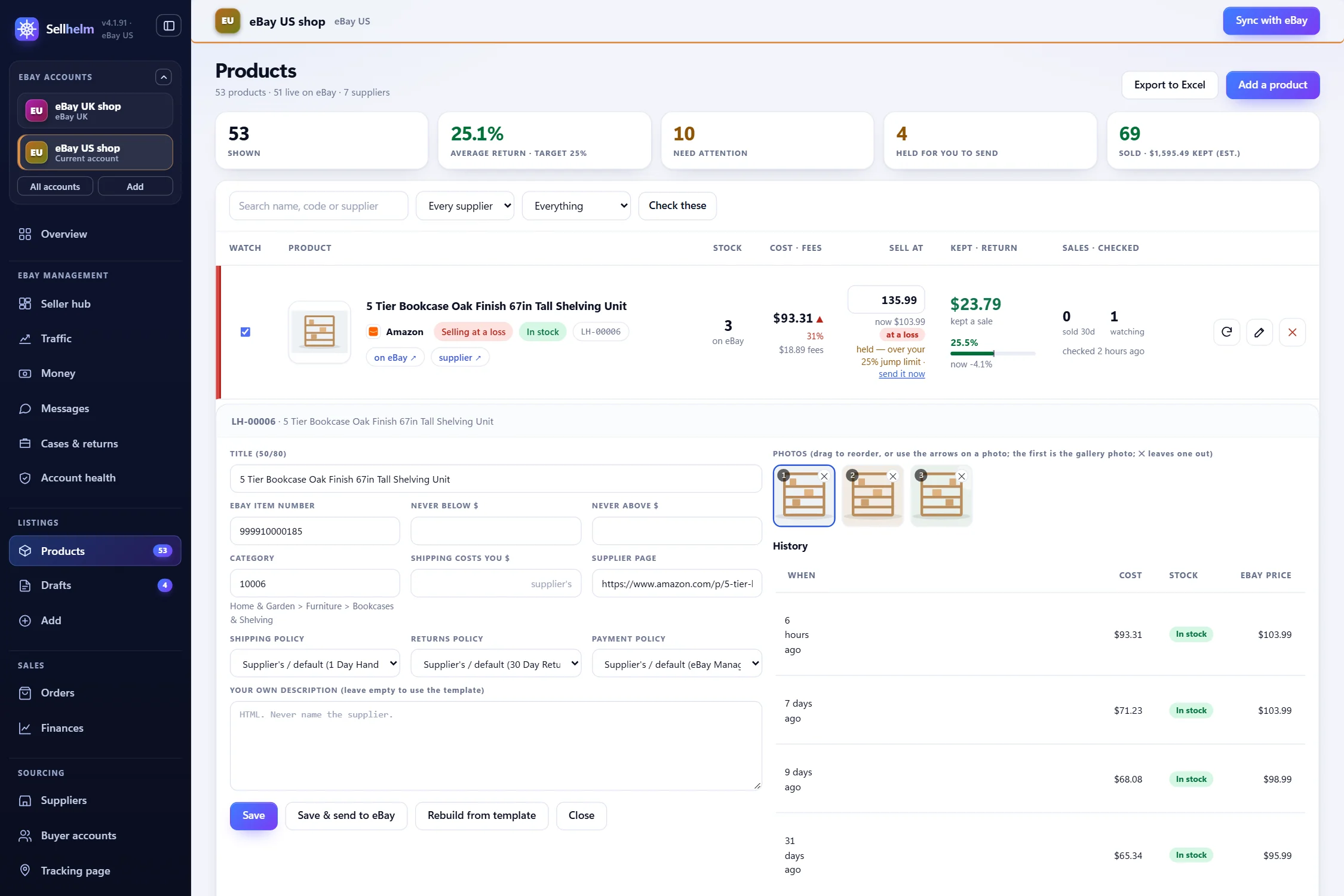
Suppliers change prices without telling you. If the cost rises and your listing stays put, your return shrinks with every sale, and if it jumps a long way you can lose money until you notice. The safe habit is to re-read the supplier often, reprice automatically within sensible limits, and hold any large jump for a human to look at, because a big sudden change is as likely to be a misread page as a real price rise. Our guide to keeping stock and prices in sync covers how.
Sales tax and income tax
eBay collects and pays sales tax on your sales itself, so you do not add it to your prices or count it as income, and does not charge tax on its fees. Your profit is still taxable income, so set money aside: Sellhelm’s Finances page estimates income and self-employment tax and tracks the quarterly estimated-payment figures. What you owe and when is a question for an accountant or the IRS, not a pricing tool.
Doing it automatically with Sellhelm
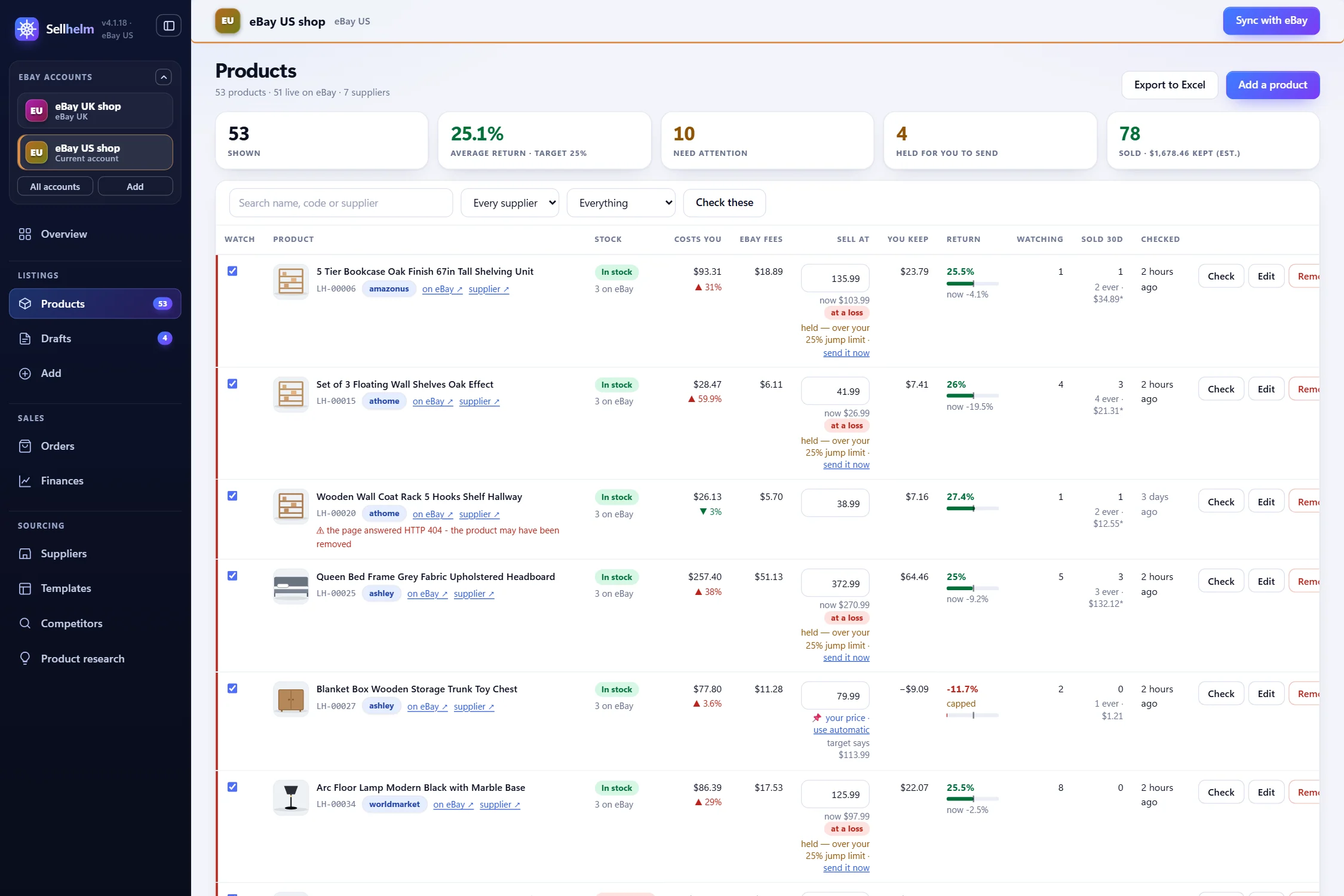
Doing this by hand once is fine. Doing it every time a supplier’s price moves, across a whole shop, is where mistakes and lost margin creep in. Sellhelm’s pricing solves for your target return on every product, using eBay’s own fee rate for each item’s category, and holds any big change for you to check first. It is one way to do it; the method above works with a spreadsheet too.
- Target return on spend %: the return you want (default 25).
- Extra on top $: added after the sum, for breakages and returns.
- Prices end in: .99, .95, .49, .00 or none.
- Never list below / above $: your floor and ceiling.
- Delivery costs you $ and Delivery you charge $ (usually 0 for free delivery).
- Hold price jumps over %: a bigger move waits for you.
Pricing is only one part of running a shop this way, and the complete guide to dropshipping on eBay US with Sellhelm walks through the rest in order.
Pricing mistakes to avoid
- Pricing from a competitor instead of from your own costs.
- Using markup and forgetting the fees come out of the whole sale.
- Forgetting to set money aside for tax.
- Using one fee rate for every category.
- Leaving delivery out of the cost.
- Ignoring returns, so a good-looking return quietly shrinks.
- Never rechecking after a supplier’s price moves.
Questions people ask
What profit margin should I aim for on eBay?
There is no universal figure. Choose a return on spend that covers returns, your time and the risk of a slow month, then check that every price actually delivers it after fees. Many sellers start around 20% to 30% return on what they spend.
How do I work out my eBay selling price?
Add up what the item costs you in total, choose the return you want on that spend, then find the price that delivers it after eBay’s final value fee and the per-order fee. Because the fees grow with the price, it has to be solved, not multiplied. The free fee calculator does it for you.
Does eBay charge fees on shipping?
Yes. eBay’s final value fee is worked out on the total amount of the sale, which includes shipping and any taxes, so the shipping you charge is part of the fee base.
Should I offer free delivery?
Often, yes for dropshipping. Build the delivery you pay into the item price, so buyers who filter for free delivery find you and the sum stays simple. Make sure the delivery cost is in your cost figure before you price.
Do I charge sales tax on my eBay prices?
No. eBay collects and pays sales tax on your sales itself, so you do not add it to your prices. Your profit is still taxable income, so set money aside and ask an accountant what you owe.
How do I price a very cheap item?
Carefully. eBay’s fixed per-order fee is a bigger share of a small sale, so cheap items need a bigger uplift on cost. Test the numbers in the fee calculator before you list, and skip anything that cannot reach your target.
What is the difference between markup, margin and return on spend?
Markup compares the price to the cost and ignores fees. Margin is profit as a share of the selling price. Return on spend is profit as a share of what you spent on the item, which is the figure that answers how much you get back for every dollar you put in.
Should I match a cheaper competitor?
Only if the price still clears your floor and your minimum return. A cheaper competitor may be losing money or buying at a different cost. Compete on delivery, photos and titles instead of giving margin away.
How often should I reprice?
Whenever the supplier’s price or the fees change. By hand that is slow, which is why most sellers automate it and hold large jumps for a person to check.