
The short version
- Garden furniture usually sells for more per order than typical dropshipping categories, which means the same sales volume produces a meaningfully larger profit at an identical margin.
- The Furniture and Furnishings (Fire)(Safety) Regulations do not cover purely outdoor garden furniture with no intended indoor use - but the general duty to supply safe products under wider UK product safety law still applies regardless.
- "Weatherproof" and "all-weather" are claims you make, and claims you have to be able to stand behind - natural rattan genuinely does not survive a UK winter outdoors; synthetic (PE/HDPE) rattan on an aluminium frame is a different, and different-sounding, product.
- Sales are seasonal, sharply so - spring and early summer carry most of the year's volume, which changes how stock, cashflow and even returns behave compared with a category that sells evenly all year.
- Bulky sets often cannot travel on a standard parcel courier at all - pallet delivery and two-man delivery are real, different logistics a smaller-item dropshipper never has to think about.
Why garden furniture is a genuinely different category to dropship
Most of the advice aimed at new dropshippers is written with small, cheap, easily-posted items in mind - phone cases, kitchen gadgets, small home accessories. Garden furniture sits at the opposite end of nearly every one of those dimensions: higher average order values, heavier and bulkier items, a sharply seasonal buying pattern, and genuine material and safety questions that a £15 gadget never raises. None of that makes it a worse category to dropship - the higher order values in particular are a real advantage, since the same number of monthly sales as a low-value category produces a proportionally larger profit at an identical margin percentage - but it does mean the generic dropshipping playbook needs real adjustment before it fits.
Selling a category that has an actual season
Garden furniture sales are not spread evenly across the year the way many dropshipping categories are - the overwhelming majority of annual volume lands in spring and early summer, as UK buyers furnish their gardens for the year ahead, with a much quieter autumn and winter either side of it. This has real, practical consequences beyond just "sell more in summer." Supplier stock is tightest exactly when demand peaks, since every other seller sourcing from the same suppliers is buying at the same time - checking stock and price more frequently during the season, not just when first listing a product, matters more here than in a category with steadier year-round demand. Pricing discipline also matters more in-season: a price that looked comfortable in a quiet month can quietly compress as a popular supplier's own costs rise under peak demand, and not rechecking it regularly is an easy way to sell the season's most popular set at a margin that no longer covers what it costs to source.
Which safety rules actually apply, and which do not
Covered in full in the furniture fire safety post, but worth restating for this category specifically: the Furniture and Furnishings (Fire)(Safety) Regulations 1988 do not reach purely outdoor garden furniture with no intended indoor use - a genuine dining set or sun lounger built and sold specifically for outdoor use sits outside that particular labelling requirement. That is a real, meaningful difference from indoor upholstered furniture, not a technicality to gloss over.
It does not mean garden furniture is unregulated, though. The wider General Product Safety Regulations 2005 still apply to every consumer product sold, garden furniture included, and a dropshipper who lists a product exactly as received - untouched, unassembled, unrepackaged - is classed as a distributor under that framework, with a genuine duty of due care rather than a testing obligation. The practical version of that duty here is the same one covered throughout this blog: ask a supplier a direct, specific question about a product's safety and construction before listing it, and keep the answer, rather than assuming an outdoor product needs no checking at all just because the specific fire-safety labelling rule does not reach it.
Cushions and seat pads can be a different story entirely
The outdoor exemption applies to the furniture itself - a genuinely outdoor-only frame and structure. Scatter cushions, seat pads and covers sold alongside a set are a separate question, because the fire safety regulations' own scope, covered in full in the dedicated post, explicitly names cushions among the items covered - and a cushion is not automatically exempt just because it happens to be sold as part of a garden set. Checking whether the specific cushions in a set are labelled to the regulations, separately from checking the frame itself, is worth doing rather than assuming the whole set is covered by the same outdoor exemption.
"Weatherproof" is a claim, not a marketing word
This is the single most common way a garden furniture listing goes wrong, and it has nothing to do with the supplier being dishonest - it is usually just an imprecise word carried over from a listing template. Natural rattan, however it is finished, is not built to survive a genuine UK winter left outdoors - the material itself will rot and weaken in cold, wet conditions over time. Synthetic rattan - woven from UV-stabilised PE or HDPE resin fibres over an aluminium frame - is a materially different product, built specifically to resist UV and weather, and manufacturers backing it typically offer a real guarantee period, commonly in the range of one to three years, as evidence they mean the claim.
The practical rule for a listing is simple: know which material a specific product actually is before calling it "weatherproof" or "all-weather," and never let those words survive a copy from a supplier's page onto your own listing without having actually confirmed which the item is. A buyer whose natural-rattan-but-marketed-as-weatherproof set degrades after one winter outdoors has a real complaint, and it is exactly the kind of "not as described" case that counts against your account when it escalates - not because the product was faulty, but because the listing promised something the material was never going to deliver.
Durability is a legal expectation, not just a nice-to-have
Under the Consumer Rights Act 2015, goods have to be of satisfactory quality, and durability is explicitly one of the factors that feeds into that standard - a garden set is reasonably expected to last more than one season, not fall apart at the first real test of British weather. A buyer has a short-term right to reject faulty goods within 30 days, and for the first six months after that, any fault is presumed to have been there from the start unless the seller can show otherwise. For a category where "it rusted" or "it faded within weeks" is a realistic complaint if the wrong material was oversold as something sturdier, this is worth knowing before the first case ever lands - it is not a technicality that only matters for electronics.
The other common materials, and what each one actually needs said about it
Rattan gets most of the attention because the natural-versus-synthetic confusion is so common, but it is far from the only material in this category, and each of the others carries its own honest claim to get right:
| Material | What genuinely holds up outdoors | The claim worth checking |
|---|---|---|
| Solid wood (teak, acacia, eucalyptus) | Naturally weather-resistant hardwoods, with occasional oiling | Whether it is a genuinely weather-hardy species or a softwood needing a cover and treatment to survive |
| Powder-coated steel or aluminium | Aluminium resists rust indefinitely; steel depends entirely on the coating staying intact | Whether the coating carries a real rust guarantee, not just a description of the finish |
| Synthetic rattan (PE/HDPE) | Genuinely weatherproof when UV-stabilised, on a rust-resistant frame | Whether the frame underneath the weave is aluminium (holds up) or untreated steel (will not) |
The pattern across all three is the same one this whole section is really about: the material name on its own tells you less than the specific construction behind it, and a supplier who can answer a direct question about that construction is a different kind of supplier to one who can only repeat the listing's own marketing language back to you.
Delivery: the part a small-item dropshipper never has to think about
A dining set, a corner sofa, or a set of loungers is often genuinely too large or heavy for a standard parcel courier, and this is where garden furniture stops behaving like most dropshipping categories at all. Very large or heavy items commonly move by pallet delivery instead - a service built for items roughly 150kg to 1,000kg, which avoids the oversize surcharges a standard parcel courier applies well before that weight, but which also changes what "delivery" actually looks like for the buyer: a pallet typically arrives on a kerb, not carried into a room. Anything requiring more than one person to move safely - a large corner set is a common example - needs a genuine two-man delivery service specified up front, not assumed to be included in a standard quote.
None of this is exotic once you know to look for it, but it has to be built into the postage policy and the listing's own delivery wording from the start, not discovered after the first oversized item gets an unexpected courier surcharge or turns up on a pallet a buyer was not expecting. Setting an honest postage policy per supplier matters even more here than in a category where every item fits the same courier the same way.
What to do about the quiet months
The obvious temptation in autumn and winter is to simply stop paying attention to the category until spring, but that is usually a mistake for two different reasons. Genuine clearance demand exists in the off-season from buyers planning ahead or catching a lower price before the next season's stock arrives, and a supplier's own stock and pricing are far easier to check calmly with no seasonal rush distorting them - meaning the quiet months are actually the better time to do the deeper supplier vetting covered elsewhere on this blog, ready for the following spring rather than rushed together once demand has already picked up. A shop that treats garden furniture as a year-round category with a seasonal peak, rather than a category that switches off for six months, tends to go into the next spring already knowing which suppliers held up and which did not - instead of relearning it from scratch under pressure.
What to actually ask a garden furniture supplier
- Is this natural or synthetic rattan, and what is the frame material? The honest answer decides what you can actually claim about weatherproofing, not the supplier's own marketing copy.
- What guarantee period do you offer against fading, cracking or rust? A real answer here is itself evidence the product is built for outdoor use, not just described as such.
- How is this item delivered - standard parcel, pallet, or two-man? Get the real answer before building the postage policy, not after the first order surprises a buyer.
- Does the set require assembly, and does it arrive with instructions? A buyer expecting a ready-to-use set who receives a flat-pack one is a returns problem waiting to happen, regardless of the product's quality.
How Sellhelm handles a bulkier, more seasonal category
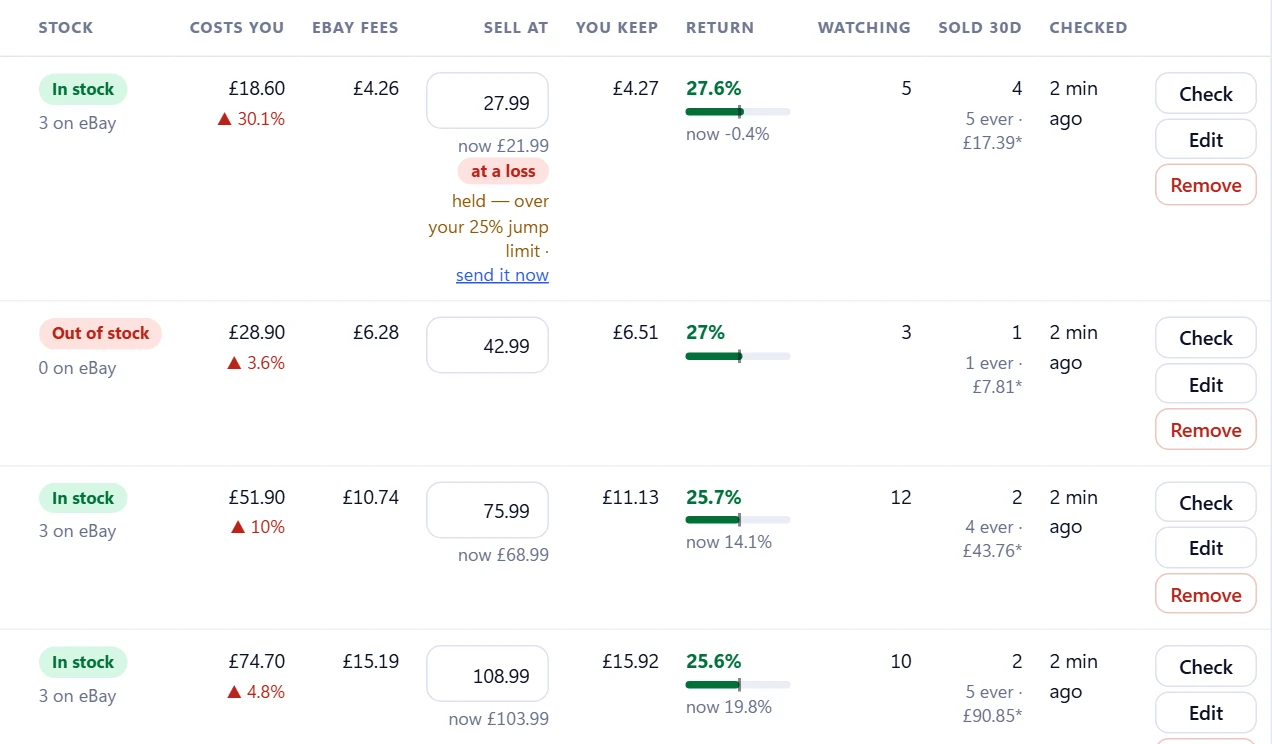
Nothing about Sellhelm changes the underlying facts of a product - whether a set is genuinely weatherproof, or whether it needs a pallet to arrive safely, are still real questions only checking the supplier can answer. What it does do is keep a supplier's stated material, dimensions and specification in one place, read from their own page rather than retyped by hand, so the details a garden furniture listing actually depends on - material, frame, delivery method - are there to check before a listing goes live, not assumed. And because supplier price and stock history is kept automatically, a popular set quietly running low exactly when the season peaks is something you see happening, not something you find out from a cancelled order.
Questions people ask
Does garden furniture need a fire safety label like sofas and beds?
No, not if it is purely outdoor furniture with no intended indoor use - the Furniture and Furnishings (Fire)(Safety) Regulations specifically exclude that. Wider general product safety law still applies to garden furniture, just not that specific labelling requirement.
Can I call rattan garden furniture "weatherproof"?
Only if it genuinely is. Natural rattan is not built to survive a UK winter outdoors and will rot and weaken over time. Synthetic rattan - UV-stabilised PE or HDPE resin on an aluminium frame - is a different product built for outdoor use, and is what "weatherproof" should actually refer to.
Is garden furniture covered by the same durability rights as other goods?
Yes. Under the Consumer Rights Act 2015, garden furniture still has to be of satisfactory quality, which includes durability - a set reasonably expected to survive more than one UK season. A buyer has 30 days to reject faulty goods, and faults are presumed pre-existing for six months after that.
Why does garden furniture sell so seasonally?
The large majority of annual demand lands in spring and early summer as buyers furnish their gardens for the year, with much quieter sales either side of it. This means checking supplier stock and price more often in-season, since demand and competition for the same stock both peak together.
How is large garden furniture actually delivered?
Items too big or heavy for a standard parcel courier often move by pallet delivery (roughly 150kg to 1,000kg), typically arriving kerbside rather than carried indoors. Anything needing more than one person to lift safely needs a genuine two-man delivery service specified up front.
What should I ask a garden furniture supplier before listing their products?
Whether the rattan is natural or synthetic and what the frame is made of, what guarantee period backs it against fading or rust, exactly how it is delivered (standard, pallet or two-man), and whether assembly is required.
Do cushions sold with a garden set need a fire safety label?
Possibly - the furniture fire safety regulations specifically name cushions among covered items, so scatter cushions or seat pads are not automatically exempt just because the outdoor furniture they come with is. Worth checking separately from the frame itself.
Should I stop selling garden furniture outside spring and summer?
Not necessarily - genuine off-season demand exists, and the quiet months are actually a good time to vet suppliers more thoroughly without the seasonal rush, ready for the next spring rather than starting from scratch under pressure.