
The strongest proof there is.
The supplier's page carries the same barcode (EAN or UPC) as the listing. It is the same product, whatever the two titles say.
Competitor research
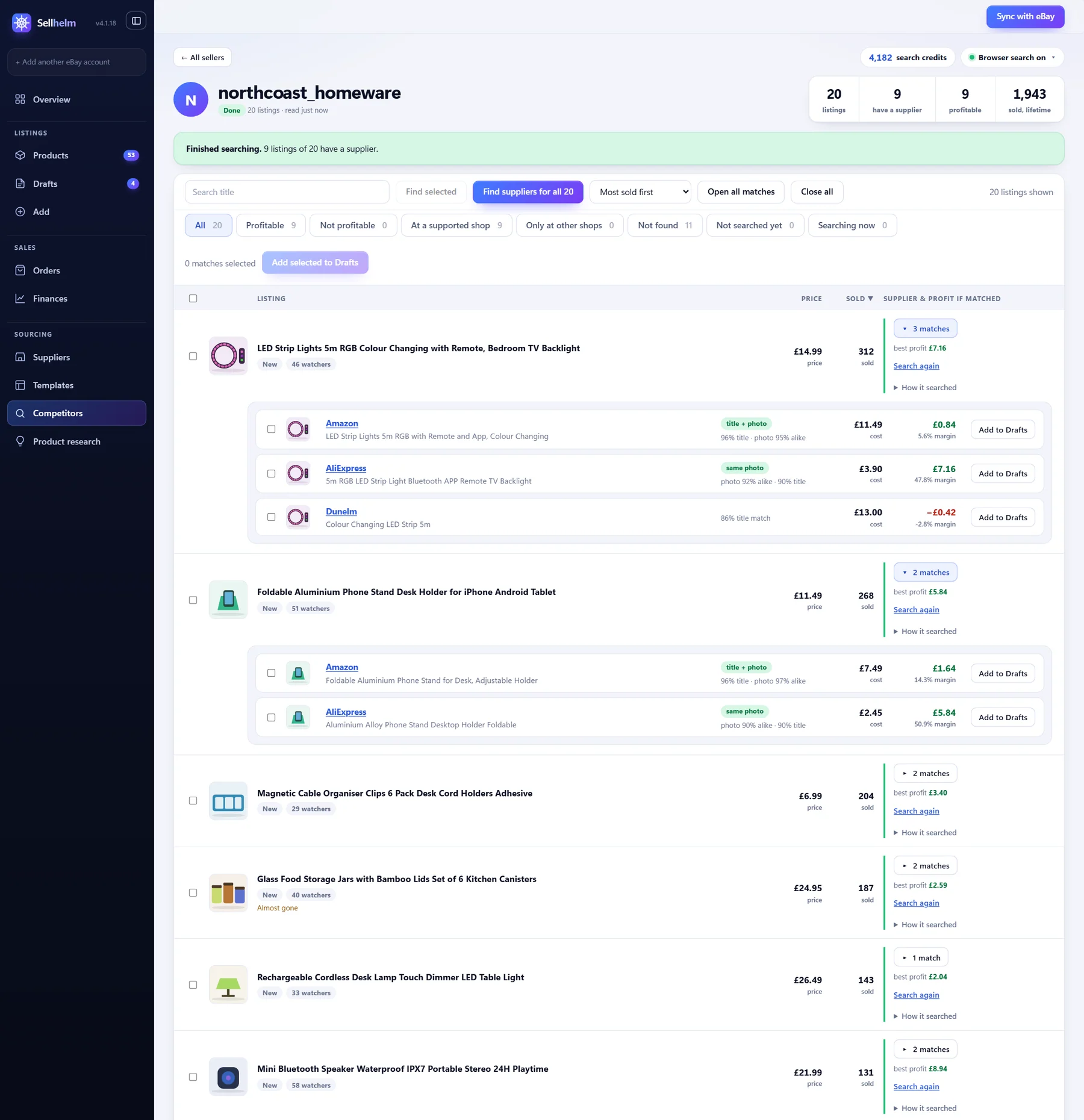
Paste a username. Sellhelm reads their whole shop, shows what has really sold and what people are watching, then tracks down where each winner comes from - and what you would keep if you matched their price.
What everyone starting out wants to know
Three questions, answered from real data instead of guesswork.
Every listing a seller has for sale, with price, condition and eBay's own lifetime sold figure and watcher count.
Sort the shop by sold, watchers or price. The listings with hundreds sold are the products proven to move.
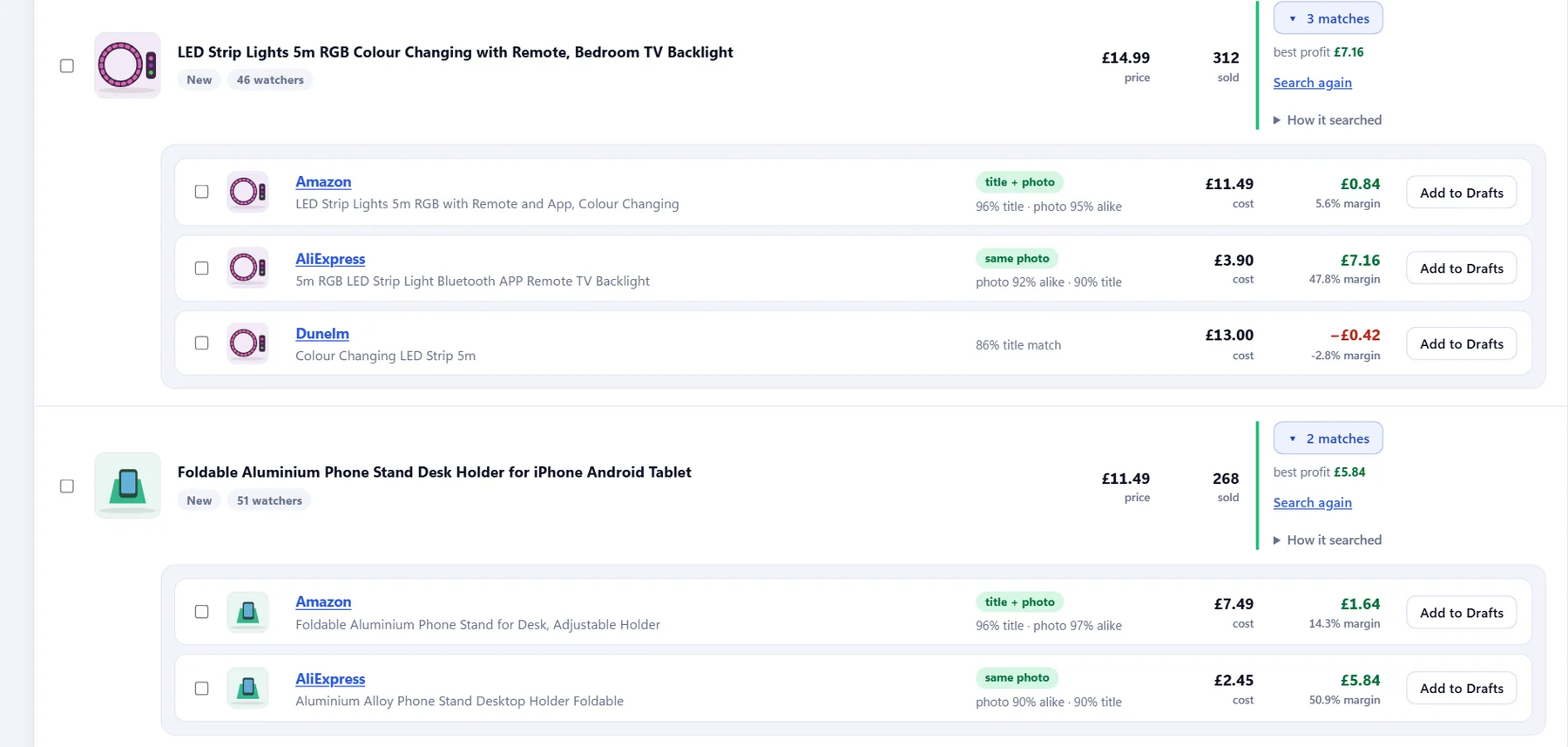
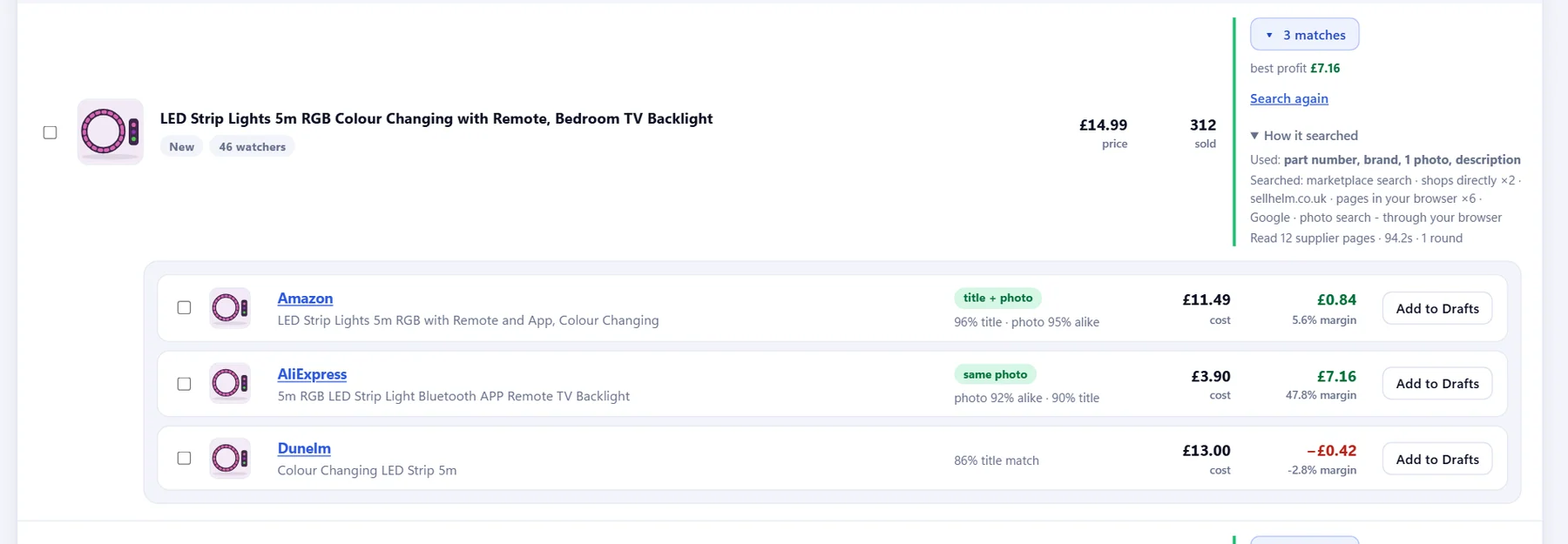
Sellhelm hunts for the supplier behind each winner and shows it with proof - and your profit if you matched their price.
Check a seller
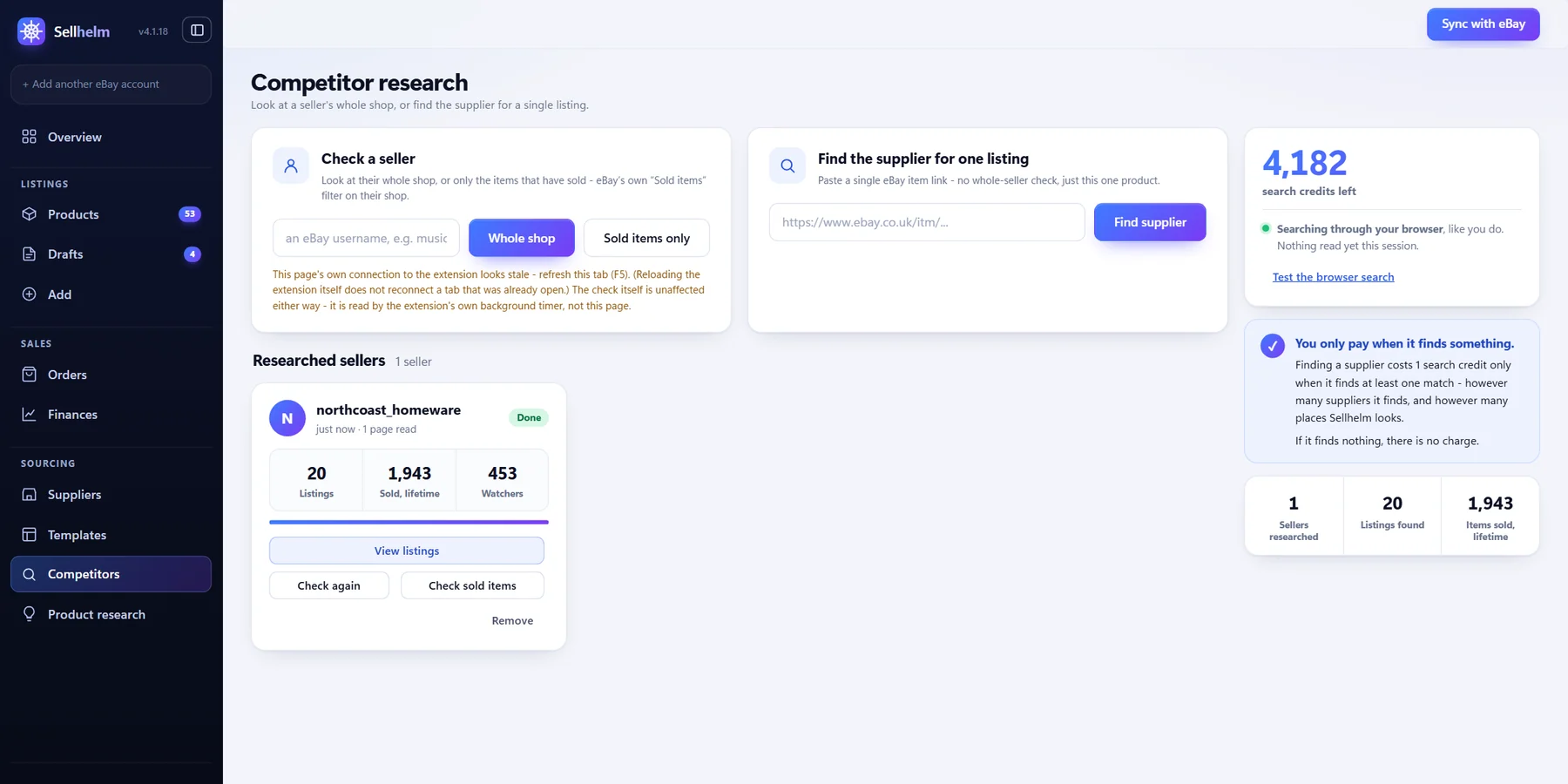
Type an eBay username. Sellhelm reads every page of what they have for sale - up to about 1,800 listings - then goes back into each listing for the figure eBay really holds: how many have sold.
Find the supplier
Pick a listing that is selling, or paste one eBay link. Sellhelm uses everything the listing says about itself - its barcode, part number, brand, item details, photos and description - and searches for the product everywhere a supplier could be.
Proof, not guesses
Every supplier match carries the evidence that it is the same product, in plain words. A near miss is never shown dressed up as a match.
The supplier's page carries the same barcode (EAN or UPC) as the listing. It is the same product, whatever the two titles say.
A listing for part CT45 is never matched to a page for part 140, however alike the words are.
The title matches almost word for word and the photograph is the same. Sizes and pack counts have to agree too: a 2-pack is not a 4-pack.
A page priced many times more than the competitor even sells for - an accessory mistaken for the machine - is ruled out.
Built for a thousand listings
"Find suppliers for all" works through a whole seller in the background, best sellers first - so the listings worth most are answered first.
Straight talk
A tool you can trust tells you where it stops.
And the other way round
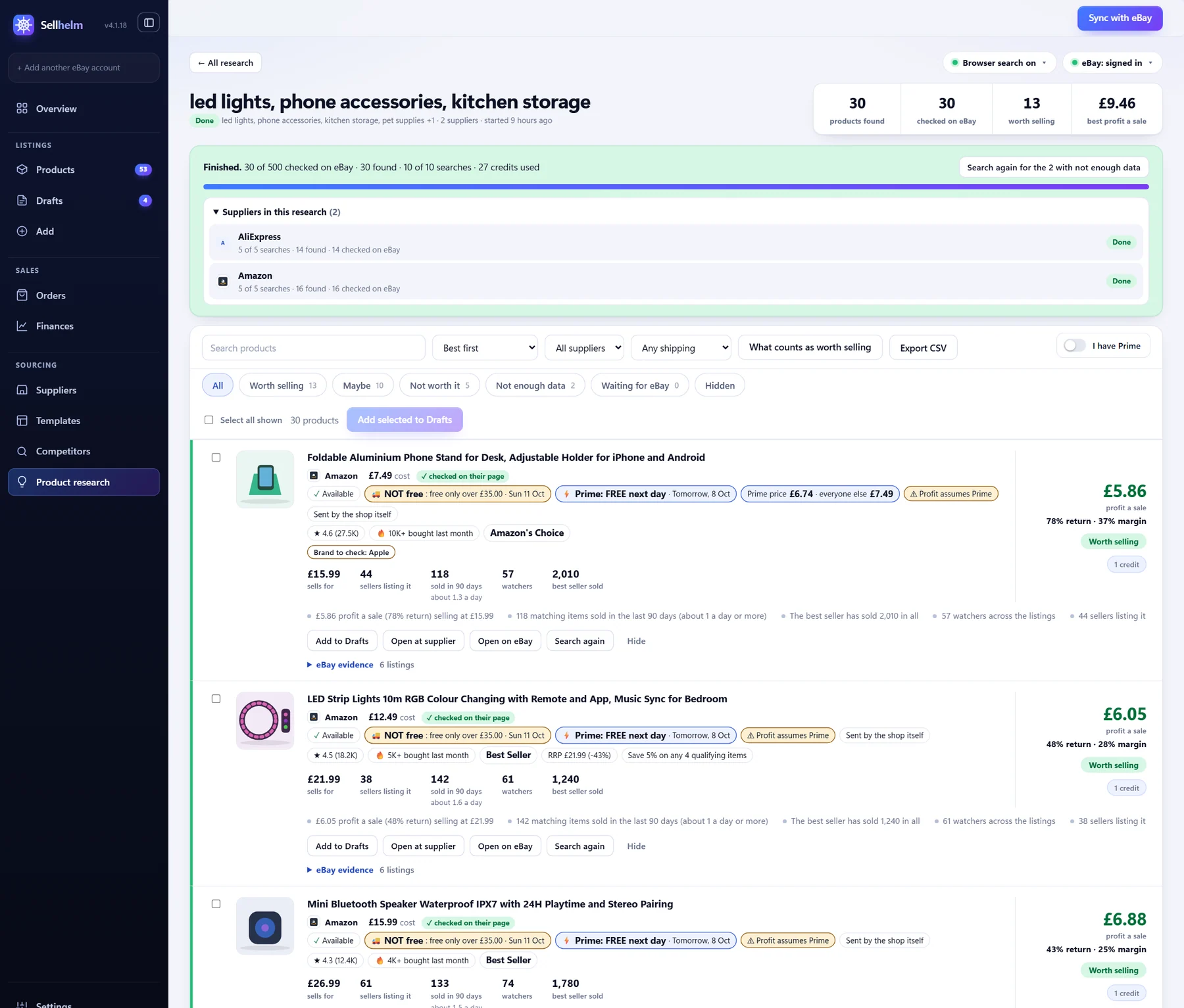
Product research finds products at your suppliers first, then checks each one on eBay - who already sells it, at what price, how much has sold - and tells you if there is money in it. It can run all night.
What it costs
Checking a seller is always free. A credit is spent only when Sellhelm finds at least one supplier for a listing - five suppliers is still one credit, and finding none costs nothing. Every pack starts with credits, and you can top up from your account at a lower price the more you buy.
Questions
More in the full FAQ, and you can ask us anything before you buy.
Yes. Next to "Whole shop" there is "Sold items only": it reads eBay's own "Sold items" filter on that seller's shop, so you see only the listings that have really sold, each with the date it last sold, and can find the supplier for any of them. It needs a browser that is signed in to eBay, because eBay shows the sold view only to someone signed in. If yours is not, Sellhelm says so and gives you a "Sign in to eBay" button. Scanning a seller again, either way, replaces their earlier results.
Everything Sellhelm reads on a seller's shop is on public eBay pages that anyone can open. It does not sign in to anyone's account, it reads through your own browser at a pace a person could keep, and it never touches a seller's listings or account in any way. You only ever look.
It is eBay's own figure for that listing, read from the listing's own page - not the search page's guess, which eBay only shows for a busy listing. It is the lifetime total for the listing, because eBay does not publish a last-30-days figure. A listing eBay shows no sold count for shows as zero.
One credit is spent when Sellhelm finds at least one supplier for a listing - however many it finds. A listing it finds nothing for costs nothing, and says so. Checking a whole seller's shop and reading their sold and watcher figures never spends a credit. (Product research spends one on each product it sends to the AI photo check, and the AI title writer in the drafts spends one each time you press it.)
All of a seller's listings, and then another seller's. "Find suppliers for all" works through them in the background, best sellers first, and carries on if you close the page or restart Sellhelm. Search engines only tolerate a person's pace, so a thousand listings takes a few hours rather than a few minutes - which is why it is built to run while you do something else.
Yes, in both countries: Amazon and AliExpress are searched directly, along with the other shops Sellhelm reads. For AliExpress, stay signed in to AliExpress in your own browser: signed out, it shows a first-order price for new customers, which Sellhelm will not use as a real cost.
If Sellhelm is confident it has found the right product at a shop it has no reader for, it still shows it, marked "other shop", and collects those shops in a panel - each one a possible new supplier. A product found at no shop it could read is marked as exactly that.
For the best results, yes. Sellhelm reads search pages and shops through your own browser, the way you would, which gets through where a program on its own is turned away. It uses one window, closes it when it has finished, and tells you plainly whether your browser is being used - with a button to test it.
Then the answer is "not at any shop we could read", and nothing is charged. That is useful to know too: a seller who sources privately, or from a supplier with no public shop, is harder to follow, and a listing that is only a generic product may have a hundred identical suppliers.
Yes. Sellhelm is built for eBay UK sellers (there is a version for the other country too), prices are in pounds, and profit is worked out with your own fee and VAT settings.
From £79.99, once. Fourteen days to change your mind.