
The short version
- Eligibility comes first: eBay requires a real wholesale supplier or manufacturer who fulfils the order for you - not another retailer or marketplace you buy from after the sale.
- Check the business is real before you check anything else - a free Companies House search and a VAT number check take minutes and catch most of the obvious problems.
- Stated dispatch and delivery times are something to read and rely on, not something to test-order and time yourself - every real supplier states them; your job is research, not reinvention.
- Paste one of their real product pages before you commit to a whole catalogue. How cleanly it reads back is itself a signal.
- Vetting does not stop at the first order - a supplier's price and stock history tells you more about reliability than their sales page ever will.
What eBay actually requires from a supplier
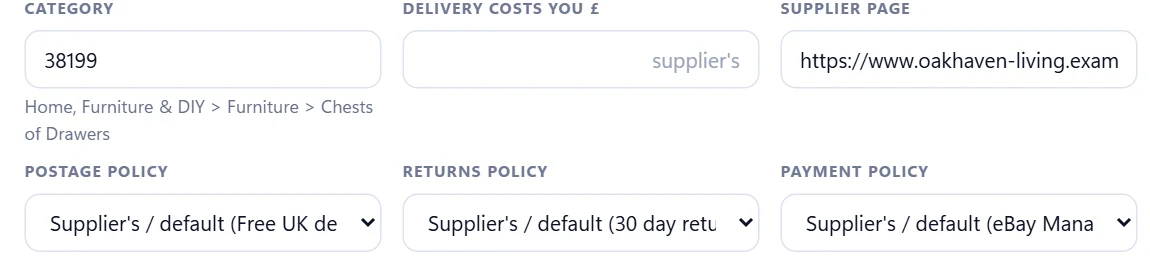
Before anything else, the supplier has to be the right kind. eBay's own dropshipping policy allows fulfilling orders directly from a wholesale supplier or manufacturer, but it does not allow listing an item and then buying it from another retailer or marketplace that ships it straight to your customer once it sells - see our guide to eBay's dropshipping policy for the detail. Everything below assumes the supplier you are looking at is the right kind to begin with; if you are not sure yet, start there first.
Where to actually look
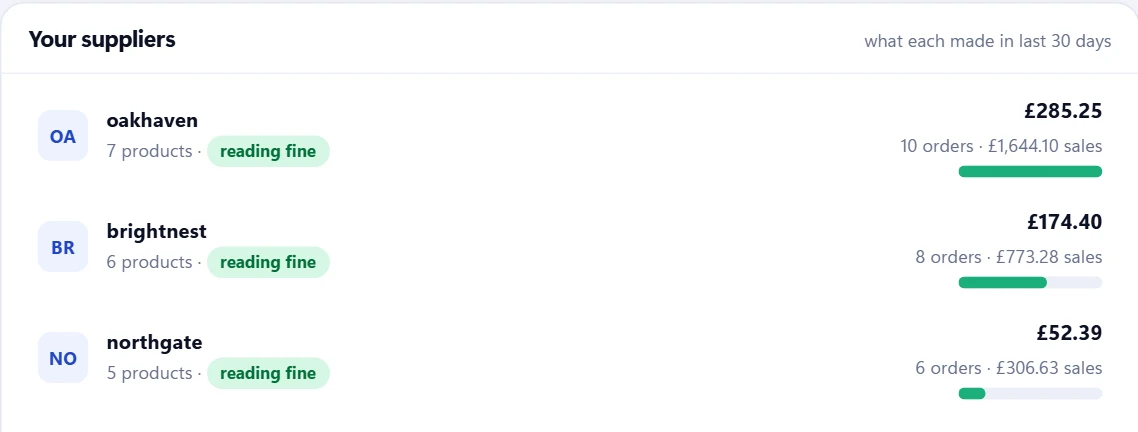
There is no single best list, and anyone selling one should make you suspicious of it. In practice, real suppliers turn up through a handful of routes: trade directories built for the purpose, going direct to a manufacturer or brand and asking whether they supply single items to end customers, wholesale sections of shops that already sell to the public, and - honestly - noticing who already supplies the sellers doing well in your own category and working out whether they would supply you too. A shop already built into Sellhelm's supplier list is a reasonable shortcut, since each one there has already been read from real product pages, but it is a starting point for research, not a substitute for it.
Check the business is real before you check anything else
This step takes minutes and rules out most of the obvious problems before you spend any real time on a supplier:
- Search the company at Companies House, free, at find-and-update.company-information.service.gov.uk. It shows the registered address, date of incorporation, current officers and filing history - a company that does not exist there, or was incorporated last month claiming years of trading history, is worth a second look before a first order.
- Check their VAT number, if they show one, at gov.uk/check-uk-vat-number. This matters for more than trust: if you are VAT registered yourself, you can only reclaim VAT on costs from a supplier who is genuinely VAT registered and gives you a proper invoice for it - see eBay dropshipping and VAT for how that actually works.
- Look for a real person behind the contact details - a UK address, a phone number that gets answered, an email that gets a reply from someone who sounds like they work there.
What to check on their own product pages
Once the business itself checks out, the individual product pages tell you the rest:
- Stock that behaves like real stock. A page that never shows low or out of stock, whatever you sell, is not tracking real inventory - it is a template.
- Plain packaging. Ask directly, before your first order, whether anything in the parcel carries their branding, prices or a different company's invoice. A buyer working out who really sent their item is a problem for your account, not theirs.
- Dispatch and delivery times you can actually promise. Every real supplier states these somewhere - read them and build your eBay postage policy to match, with a little room to spare. This is a research job, not a live trial: you are checking what they say, not ordering one to yourself and starting a stopwatch, because their stated times are what they are committing to for every order, not just yours.
- A returns route that exists on paper. Who takes a returned item back, who pays the postage, and how fast you get your money back if a buyer sends one back to you.
Red flags worth stopping for
Pricing that undercuts every comparable supplier by a wide margin, with no explanation you can find. No Companies House record for the business named on the site. A VAT number on the page that does not check out. Product photos that turn up, reverse-searched, on a dozen other unrelated sites with no obvious licensing relationship. Contact options that never produce a reply. Any one of these alone might have an innocent explanation - more than one together rarely does.
Test the page before you test the relationship
Before committing to a whole catalogue, paste one real product page from the supplier into your listing tool and see what actually comes back. Sellhelm reads a product's title, its current price, whether it is in, low, or out of stock, up to 24 photographs measured for size, up to 40 specification rows and the selling points the page itself states - and it says so plainly when it cannot: a page showing several options it cannot tell apart, a redirect, a captcha, or a price in a currency it does not handle is refused rather than guessed at. A supplier whose pages read cleanly, product after product, is usually a well-built, well-run site behind them too - not a guarantee, but a real signal, and a far better one than a sales pitch.
Watching a supplier after you have added them
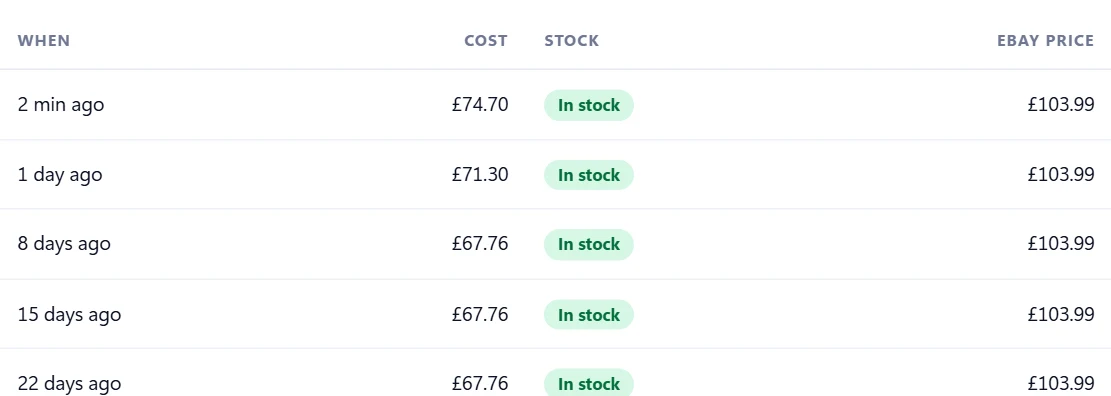
Vetting is not a one-off check the week you sign up. A supplier's price and stock history, read at every check rather than trusted from memory, is a far better read on reliability than anything on their sales page - a cost that creeps up in small, frequent steps, or stock that flips between in and out of stock more often than seems believable, tells you something a first impression never could.
How Sellhelm handles the shops it already knows, and the ones it does not
Sellhelm reads a growing list of UK shops with their own dedicated reader, built and tested against real product pages rather than guessed at generically. Paste a link from any other shop and it will still do its best with a general reader - not as reliable as a shop with its own, but usually enough to judge a new supplier's pages before you commit. Not on the list at all yet? Asking for a shop takes a minute, and the ones asked for most are looked at first.
Once a supplier is trusted, Sellhelm keeps a quiet eye on it for you: a rise past the jump limit you set is held for you to approve rather than sent straight to a live listing, and every supplier's own page - reading fine or not - sits in one place instead of buried across dozens of open browser tabs.
Questions people ask
What makes a supplier eligible for dropshipping on eBay?
A real wholesale supplier or manufacturer who fulfils the order and ships it to your buyer directly. Buying an item from another retailer or marketplace after it sells, and having that ship to your buyer, is not allowed under eBay’s own dropshipping policy.
How do I check a UK supplier is a real, legitimate business?
Search the company for free at Companies House (find-and-update.company-information.service.gov.uk) for its registered address, incorporation date and filing history, and check any VAT number it shows at gov.uk/check-uk-vat-number. Together these take a few minutes and rule out most of the obvious problems.
Should I place a test order to check a supplier’s delivery times?
Not as your main method. Every real supplier states its dispatch and delivery times somewhere - reading and relying on those, with a little room to spare in your own eBay policy, is the research that actually matters, since those are the times they are committing to for every order, not only one you happen to time yourself.
Does Sellhelm only work with certain suppliers?
No. It has its own dedicated reader for a growing list of UK shops, and a general reader that does its best with any other shop’s product page you paste in - useful for judging a brand new supplier before you commit to it. You can also ask for a shop to be added.