
The short version
- The £90,000 VAT threshold is based on turnover - everything a buyer paid you - not profit. A dropshipper can cross it on thin margins while still keeping very little.
- It is tested two ways: your trailing 12 months (not the tax year, a rolling window) and whether you expect to cross it in the next 30 days.
- Once registered, you charge VAT on your eBay sales and can reclaim VAT your suppliers charged you - but only with a valid VAT invoice for it.
- VAT on eBay's own fees is a separate charge, at 20%, that applies whether or not you are registered - only a registered seller can reclaim it.
- The Flat Rate Scheme gives up most of your ability to reclaim VAT on goods, which can cost a dropshipper more than it saves - worth an accountant's opinion before you pick it, not after.
The £90,000 threshold is based on what you sell, not what you keep
This is the single most common misunderstanding, and it hits dropshippers harder than most other sellers. The VAT registration threshold is measured against your taxable turnover - the total value of everything you sell - not your profit. If you sell £95,000 of stock in a year and keep £14,000 of it after your suppliers and eBay's fees, you have still gone over the threshold. The thin margins that are completely normal in dropshipping do nothing to protect you from it, because the threshold was never measuring margin in the first place.
Turnover is everything a buyer paid you. Profit is what is left once everyone else has been paid. The threshold only ever looks at the first one.
How the threshold is actually tested
There are two separate tests, and either one on its own is enough to require registration:
- The trailing 12 months. Not your tax year, not the calendar year - a rolling window that moves every single day. GOV.UK's own wording is that you must register once "your total taxable turnover for the last 12 months goes over £90,000." Check it against the last 12 months from today, not from your last accounts.
- The next 30 days. If you can see it coming - a big new range going live, a wholesale order about to go out the door - and you genuinely expect to cross £90,000 within the next 30 days, you must register on that basis alone, before the trailing-12-months test would otherwise have caught it.
Watch the trailing 12 months, not April to April
Because the window rolls daily, a strong month a year ago can drop out of the count at the same time a strong month this year drops in - so the number can move even on a day you sell nothing. Check it monthly rather than assuming a good tax year is the only thing that moves it.
What changes the day you register
Two things happen at once, and dropshippers tend to notice the first and forget the second:
- You must charge VAT on your eBay sales. UK consumer pricing has to be VAT-inclusive, so your listed price already has to have the VAT built in - not added on at checkout.
- You can reclaim VAT your suppliers charged you, provided the supplier is itself VAT registered and gives you a proper VAT invoice for it. No invoice, no reclaim, whatever the receipt says.
The gap between what you charge (output VAT) and what you can reclaim (input VAT) is what you actually owe HMRC for the period - not the full VAT on your sales, which is the other common misunderstanding. A seller with high genuine costs from VAT-registered suppliers can end up owing comparatively little, because most of the VAT they charged was already paid out again to a supplier and reclaimed.
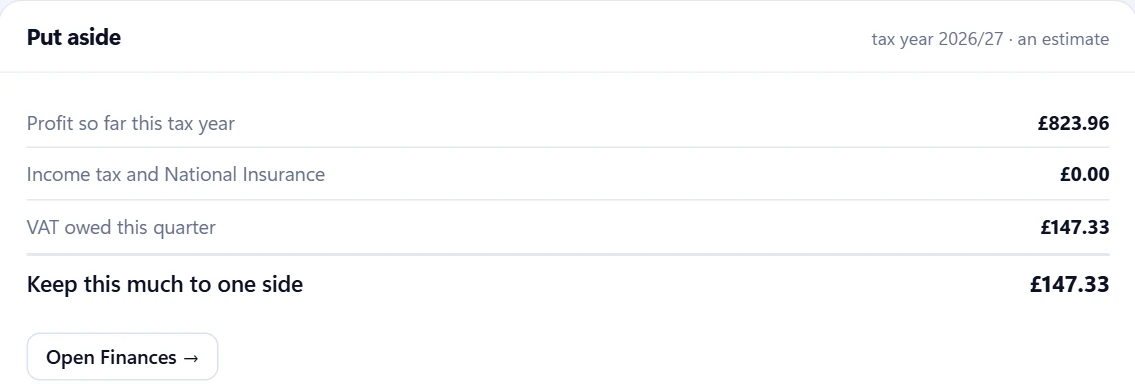
A worked example makes the gap concrete. Say an item sells for £120, VAT included - £20 of that is VAT you owe HMRC on the sale (Box 1). You paid a VAT-registered supplier £60 for it, and £10 of that was VAT you were charged (Box 4). What you actually owe HMRC for that sale is £20 minus £10, or £10 - not the full £20 a seller new to this often expects to set aside.
Registering before you have to
Nothing stops you registering early, before your turnover forces it, and some dropshippers do it on purpose. The trade-off runs the other way from the one above: you start charging VAT on every sale immediately, which can make you look more expensive against a competitor who is not registered, but you also start reclaiming VAT on your supplier costs straight away instead of only once you are forced to. Whether that is worth it depends on your margins and your suppliers, which is - again - a conversation for an accountant with your real numbers in front of them, not a rule of thumb.
VAT on eBay's fees is a different charge entirely
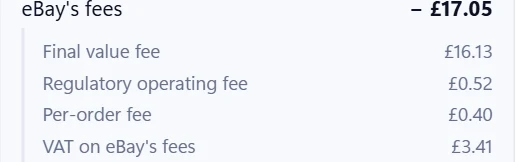
This is where a lot of sellers talk themselves into confusion. eBay charges VAT at 20% on its own selling fees - the final value fee, the per-order fee, the regulatory operating fee - to every UK seller, registered or not. Seeing "VAT" on your eBay invoice does not mean you are already charging VAT on your sales, and it does not mean you are registered. It is eBay's own VAT, on eBay's own charge to you, and it is simply a cost if you are not registered yourself. Only once you are VAT registered can you reclaim that portion back, the same as any other input VAT.
The Flat Rate Scheme is not automatically the simple option
Once registered, HMRC offers a Flat Rate Scheme: pay a fixed percentage of your gross turnover instead of working out output VAT minus input VAT every quarter. It sounds simpler, and for a business with low costs it can be. For a dropshipper, it is worth real caution, because the trade-off is real:
| Standard VAT accounting | Flat Rate Scheme | |
|---|---|---|
| VAT on supplier costs | Reclaimed in full, with a valid invoice | Not reclaimed, except capital goods over £2,000 on a single item |
| What you pay HMRC | VAT you charged, minus VAT you can reclaim | A fixed percentage of your gross turnover, regardless of your real costs |
| Best suited to | Sellers with real, VAT-bearing costs - most dropshippers | Businesses with genuinely low costs relative to turnover |
Because dropshipping means most of what you spend is on VAT-bearing stock from a supplier, giving up the ability to reclaim that VAT is usually a worse trade than it looks on the surface, even against a lower headline percentage. Whether it works out better or worse for your own numbers is exactly the kind of question worth putting to an accountant before you pick a scheme, not after a year of paying into the wrong one.
How Sellhelm keeps track of all this
None of the rules above change with software, but tracking where you stand against them by hand, from memory, is how sellers miss the threshold until it has already passed. Sellhelm's Overview keeps a rolling 12-month watch on your turnover against the registration threshold as part of its "Needs you" strip, so it is one of the things flagged before it becomes a problem, not after.
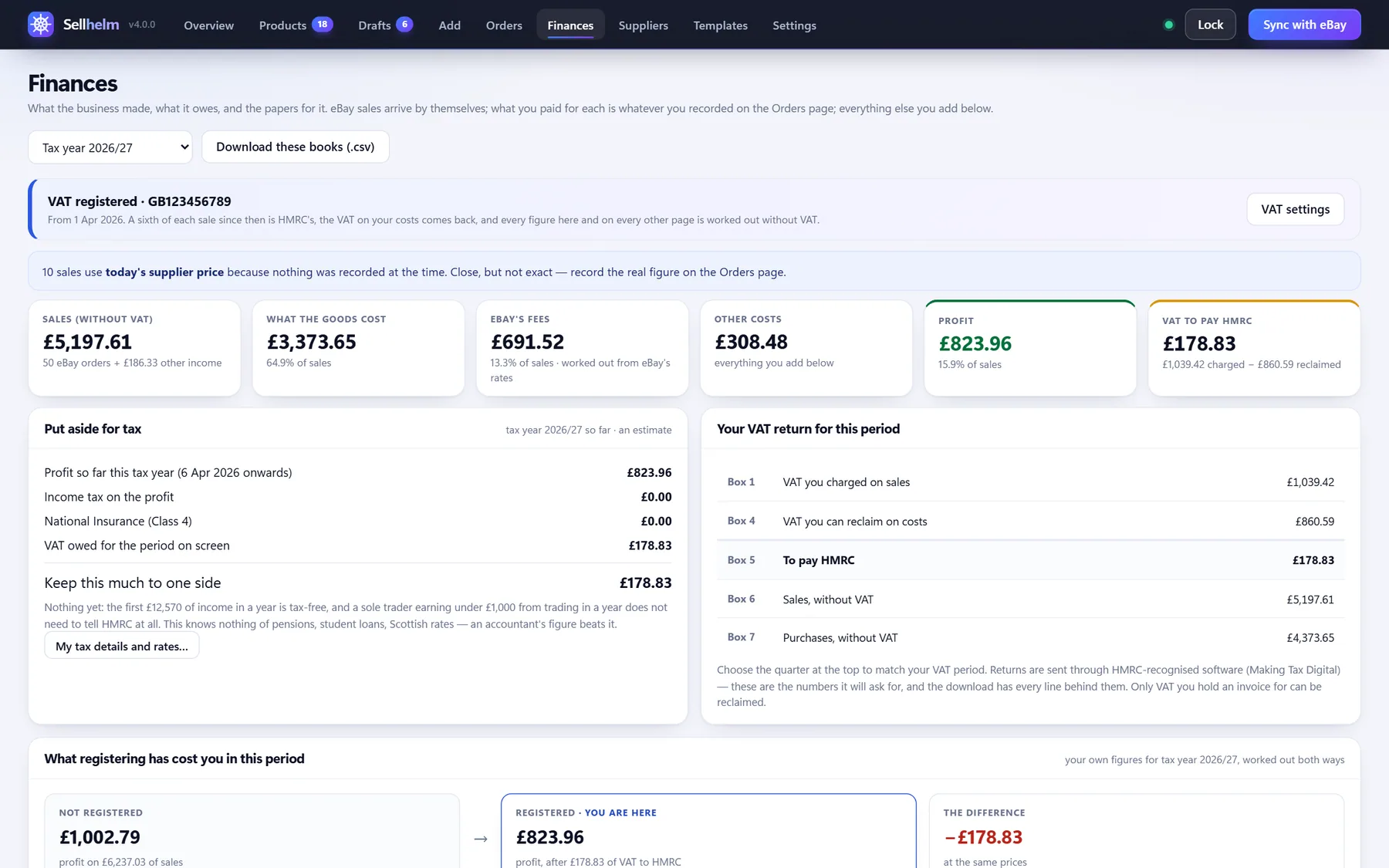
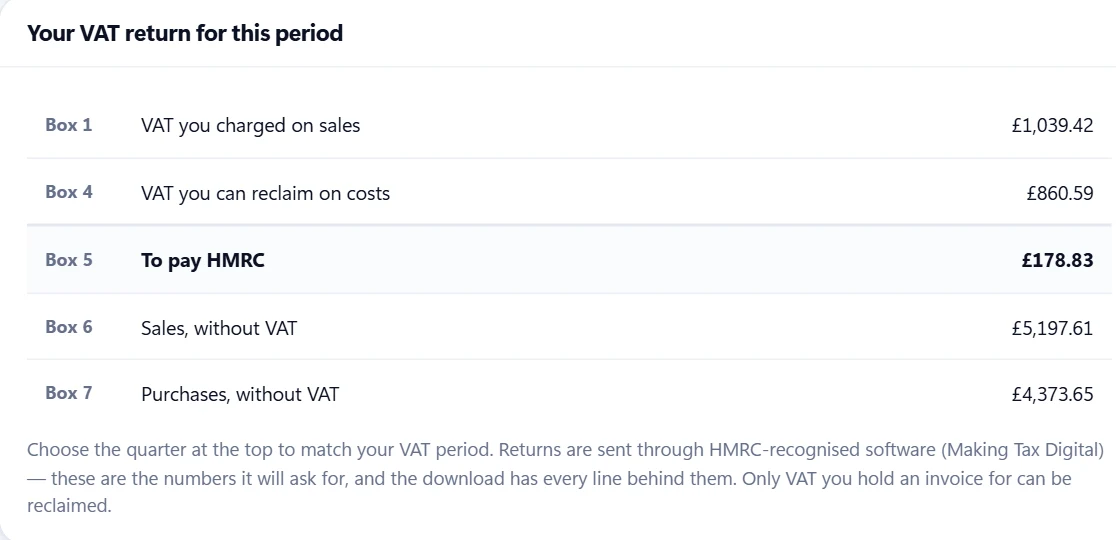
Registered or not, the sums come out right for your situation: not registered, VAT on eBay's fees is simply counted as a cost, the way it actually is for you; registered, prices are worked ex-VAT and the input VAT on your costs is reclaimed properly. Finances then lays out the five VAT return boxes HMRC actually asks for - box 1, VAT charged on sales; box 4, VAT reclaimed on costs; box 5, the net figure to pay; boxes 6 and 7, sales and purchases excluding VAT - ready for Making Tax Digital software, with the working behind every line for your accountant to check. Only VAT you hold a real invoice for is ever counted as reclaimable, the same rule HMRC applies.
Whether and when to register is still a decision for an accountant or GOV.UK, not a piece of software - what Sellhelm actually does is make sure you are looking at the real number when you have that conversation, instead of a guess.
Questions people ask
Is the £90,000 VAT threshold based on profit or turnover?
Turnover - the total value of everything you sell, not what you keep after suppliers and eBay’s fees. A dropshipper with thin margins can cross it while keeping comparatively little of it as profit.
Do I pay VAT on eBay’s fees even if I am not VAT registered?
Yes. eBay charges 20% VAT on its own selling fees to every UK seller regardless of your own VAT status. If you are not registered, it is simply a cost; if you are, you can reclaim it like any other input VAT.
Should I use the VAT Flat Rate Scheme as a dropshipper?
Not automatically. The Flat Rate Scheme gives up your ability to reclaim VAT on most goods, which is usually a worse trade for a dropshipper than it looks, since most of your costs are VAT-bearing stock from a supplier. Ask an accountant to run your actual numbers both ways before choosing.
Does Sellhelm tell me when to register for VAT?
It shows you where you stand - a rolling 12-month turnover watch against the threshold, flagged before it becomes urgent - but the decision itself is a question for an accountant or GOV.UK, not something a pricing and stock tool decides for you.
Can I register for VAT before I hit the threshold?
Yes - registering early is allowed, and some sellers do it deliberately because it lets them reclaim VAT on supplier costs sooner. The trade-off is charging VAT on every sale straight away too, so whether it is worth it depends on your margins and your suppliers.